Beastmen to Bonfires: Alpine Folk Customs Through the Seasons

The Alps span several geopolitical borders and encompass significant cultural and linguistic diversity, and yet it is a region, when considered as a geographical entity rather than as a serious of nations, united by its folk customs.

Rooted in pre-Christian, nature-worshipping Alpine religions, many local legends, calendar customs, and artisanal crafts in Italy’s Trentino-Alto Adige/South Tyrol continue to reflect the deep connections with the natural landscape that characterize Alpine folklore and folkways. Grounding them all is a ritualistic acknowledgement of the extreme seasonal shifts, isolation, and solitude inherent to mountain life. 

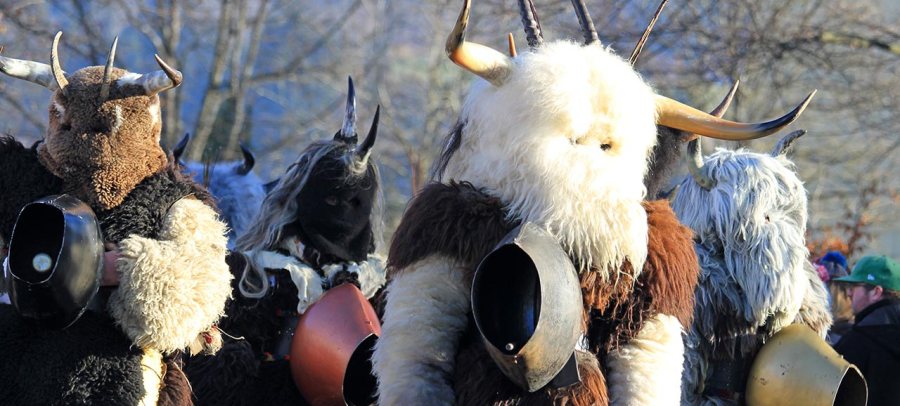
Alpine Beastmen. South Tyrolean festivities that mark significant cyclical transitions—such as the winter and summer solstices, the end of the harvest, or the arrival of spring—feature a host of folkloristic figures who congregate in spectacular public events. These include the Perchtenlauf, followers of the pagan Alpine goddess Perchta who are collectively known as Perchten. The Perchten wear frightful animal costumes and bang on massive drums to drive out winter darkness as they follow their leader, a Hex who symbolically “sweeps up” the previous year’s evil to be tossed into the fire. 

A similar figure is Krampus, another anthropomorphized beastman who inhabits the wintry Alpine and northern European realms. Every year, on the eve of Saint Nicholas Day, Krampuslauf parades take place throughout Trentino-Alto Adige, in towns like Pergine (near Trento) and Dobbiaco (east of Bolzano), with Krampus teasing and terrifying onlookers as part of the larger Saint Nicholas festivities. 

Other customs in this region include the Klöckeln, when costumed figures knock on farmhouse doors in villages like Varna and Scalares in the Val Sarentino on the first three Thursdays of Advent—the Christian liturgical season leading up to the arrival of Christ. Similar to winter mumming, the ritual involves great secrecy among the participants, whose peculiar white masks, long mossy beards, and floppy red noses entirely disguise their identities. According to tradition, sweets and wine must be offered to the Klöckeln, who then conclude the visit by etching a crucifix on or near the threshold, such as on the doorfront or in surrounding snow. 

Wood Carving. South Tyrol’s long tradition of wood carving can be admired in places like Val Gardena in the Dolomites, where local artisans have been carving wooden toys, figurines, and large, elaborate nativity scenes for centuries. Wood carving is also the foundational craft employed to create Krampus’s strikingly grotesque and beastly appearance, typically made from local pine. The masks are then further embellished with ram or goat horns, furs, and faux skins, before being painted to frightening effects. The Maranatha Nativity Museum in Luttago (in the province of Bolzano) houses a collection of these handcrafted masks, with an atelier showcasing their evolution from blocks of wood into depictions of the devilish face we associate with Krampus.

Summer Bonfires. Lighting bonfires—falò in Italian—to mark the summer solstice is an ancient and common practice throughout Europe, derived from pre Christian sun worship rituals that in Italy have merged over centuries with Saint John the Baptist observances in late June. The practice continues today, with the month of June in South Tyrol seeing its mountain slopes and high peaks light up in a dramatic display of flames, creating a wondrous spectacle that spans the dark-of-night landscape for miles. 

In a specific derivation of the midsummer falò tradition, South Tyroleans commemorate the successful Tryolean defeat of Napoleonic forces in June of 1796 with the lighting of Herz-Jesu Feuer, or Sacred Heart of Jesus fires. These fires, which are lit on the third Sunday after Pentecost—coinciding with the summer solstice period—recall the Tyrolean troops’ pledge to the Sacred Heart as they organized their defense against the imminent French invasion. The act of burning immense heart shapes and crosses in June has come to symbolize resistance, Tyrolean unity, and divine protection. 

pictured: Klöckeln in Sarntal Valley; photo @ sudtirol.com 

nb: a version of this piece first appeared in Italy Magazine’s Bellissimo, Winter 2023 Edition, Trentino-Alto Adige. Subscribe here!

La Festa di San Giuseppe

It’s nearly impossible to overstate the significance of Giuseppe, foster father of Christ and patron saint of fathers, who functions as a symbolic paternal figure for Italians and whose feast day is, not by coincidence, la festa del papà.

Marked by abundance and giving, Saint Joseph’s Day is a categorically food-focused celebration of spring’s bounty. In countless communities throughout southern Italy and Sicily, the days leading up to March 19 see an ambitious and communal food-making endeavor, resulting in banquets so lavish and plentiful they seem to mock the very idea of hunger, if not vanquish it outright for the remainder of the year. No matter how many hungry guests gather round one’s table on San Giuseppe, there must always be leftovers to give to neighbors or homeless people.

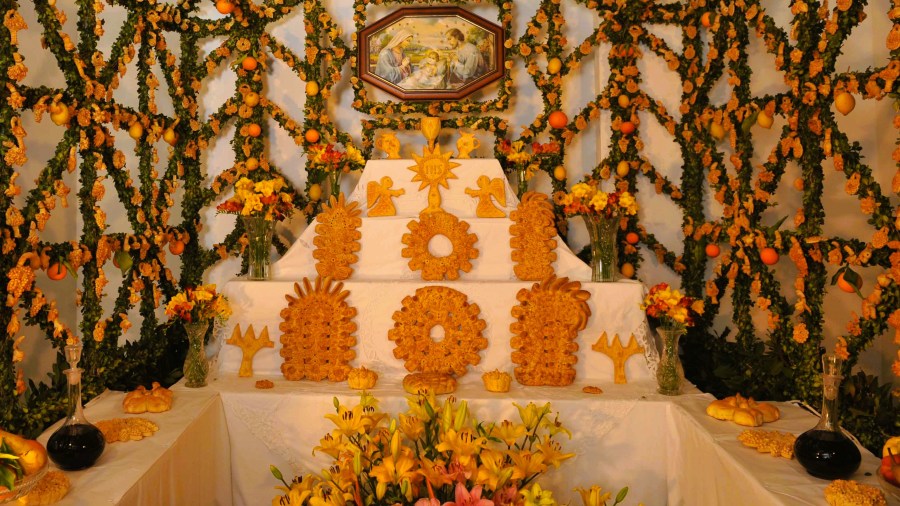
At the center of the feast is the Saint Joseph’s altar or table, upon which this mountain of food will be arranged. Nothing is placed on the table by chance; every item embodies some emblematic association or auspicious end. Bread takes center stage, as the most perfect expression of man’s toils transformed into sustenance, and recalling as well the ancient Roman grain festivals once observed during the winter-spring transitional period. Sweets, particularly fried and cream-filled pastries, mean a temporary reprieve from fasting and abstinence during Lent. Flowers, asparagus, wild fennel, and fava beans laid around the table speak to springtime’s imminent return, while lemons, oranges, and wine represent the fruit of the preceding season’s labors. Fish-based dishes symbolize Christ, and meat is usually absent from the table.

The countless fascinating food rituals surrounding this holiday derive from both ancient pagan and early Christian customs. In more recent centuries, thanks to Italian immigration, San Giuseppe festivities have taken root in other parts of the world—namely America, where Italian-American communities celebrate the saint with large, potluck-like events. Here are some of the Italian foods and lore associated with this significant feast day.

Fava beans. Several spring vegetables are linked to Joseph’s feast day, yet none so strongly as the fava bean, or broad bean. According to legend, a group of drought-stricken Sicilian farmers faced starvation until the saint intervened on their behalf, bringing about a miraculous crop of fava beans. This otherwise lowly legume has since come to represent Joseph’s generosity and benevolence, and in honor of him fava beans will be placed around the table or cooked in various dishes. Moreover, the fava bean has earned a lucky charm status among Catholics, some of whom will attend mass with a fava bean in their pocket on the day.

Maccù di San Giuseppe. Perhaps no dish embodies the transitional nature of this holiday so well as the stew known as maccù di San Giuseppe. As the move from one season to the next is often characterized by purging and cleaning rituals, the customary emptying of the pantry around the equinox is said to account for this many-ingredient concoction. All the items of last season’s harvest—dried beans, peas, lentils, chestnuts—are tossed into the pot along with fresh greens, wild fennel and fava beans (of course). In making maccù di San Giuseppe, Italians at once honor the saint and ready the pantry for the spring-summer bounty to come.

Focaccia di San Giuseppe. In Puglia, a special kind of focaccia is made in honor of Giuseppe, one whose unique combination of ingredients reflects the local taste preference for things agrodolce, or sweet and sour. Anchovy, young white onions, and raisins are added to a focaccia dough with a high olive oil content, which is then rolled into a spiral shape and baked. The bread likely owes its affiliation with the saint to the type of onions used, harvested this time of year before the onion bulb is fully formed and the stalk is very tender and flavorful.

pictured: a Saint Joseph’s altar in Salemi, Sicily featuring a stunning array of homemade votive breads

Purgatory Beans

Every Ash Wednesday, the town of Gradoli in Lazio hosts a peculiarly named event: the pranzo del purgatorio, begun in the 1300s by the Fratellanza del Purgatorio, one of countless confraternities in Italy dating to the medieval period.

The event unfolds throughout the town in various phases. Prior to the lunch, the confraternity members march through Gradoli soliciting “fat” donations like prosciutto and other cured meats, livestock, or even cash. Sellable items are then auctioned in the piazza, traditionally to fund Holy Mass for souls in purgatory and the Ash Wednesday lunch for the poor. The meal, intentionally magro (lean) to mark the start of the Lenten season, consists of fish from nearby Lake Bolsena and a special variety of stewed white beans, flavored simply with herbs and olive oil. These small, soft-skinned, no-soak beans have been associated with Gradoli’s purgatory brothers so long that they’ve come to be known simply as fagioli del purgatorio—purgatory beans.

In recent years, Gradoli’s pranzo del purgatorio has transformed into a massively popular sagra that hosts hundreds if not thousands of participants. In La Cucina delle Tuscia: Storie e Ricette, Italo Arieti notes that while the menu of fish and beans remains unchanged today, the event has apparently lost its former overt associations with penance and abstention and gained an atmosphere of festive abundance (reflected by portion sizes, for instance). Arieti also tells us that those who join the lunch are no longer obliged to continuously chant Viva le anime nel purgatorio! for the souls in purgatory.