La Festa di San Lorenzo

On August 10, Italians celebrate San Lorenzo (Lawrence), patron of cooks, brewers, vintners, butchers, and bakers whose involvement in the then-considered heretical, anti-establishment early Christian religion led to his martyrdom.

It was on this day in year 258 AD that Roman officials sentenced Lorenzo to death, as punishment for his refusal to hand over various goods and treasures he oversaw as a church deacon (he distributed them to the poor instead). According to Christian lore, Lorenzo was placed on a gridiron to “cook” over hot coals, a tale that accounts for the saint’s now-legendary final words: “I’m well-done on this side. Turn me over!”

Not surprisingly, historians today dispute the factual accuracy of Lorenzo’s fantastical final hours; yet associations between the saint and his “death by grilling” remain strong. He is patron saint of barbecues and barbecuing, for instance, and cooks are known to invoke his protection in the kitchen, where burns by heat or fire are a very real threat. Italian kitchens commonly feature small Lorenzo statues, plaques, or holy cards. 

In Tuscany, San Lorenzo feasting usually means enjoying a traditional bistecca fiorentina (or other grilled meat). In this context, the role of the grill is central as the symbolic link to Lorenzo’s martyrdom on the gridiron.  Not everyone practices this fanciful (and perhaps gruesome!) manner of ritualistically recalling the death of the saint, however. In other parts of Italy, such as Naples and Bologna, the custom for some is to abstain from meat out of respect for the martyr, and thus at some San Lorenzo events, thick watermelon “steaks” are grilled in place of beefsteaks. 

Interestingly, both these foodstuffs fit neatly into the August calendar of customs: meat, especially a choice cut like the t-bone, was a rarity in the medieval and early modern peasant diet, and instead would appear on tables only during those significant cyclical festivities like Christmastide, Easter, or, as in this case, harvest time. In this sense, grilling up a decadent piece of meat to honor San Lorenzo, whose feast day coincides with the summer harvest and its attendant rituals of abundance, is fitting. At the same time, watermelons, too, are wonderfully abundant and refreshing in late-summer Italy. 

The summer grain harvest in Europe is a period whose feasting customs derive from pre-Christian August festivals such as Lammas, Lughnasadh, and Feriae Augusti. Rooted in the agrarian work cycle as well—August being both a time of reaping and a transitional period of shifting to other types of agricultural work after a festive “break”—holidays like San Lorenzo and Ferragosto / Feast of the Assumption (August 15) find expression in the popularity of bread, pasta, and other grain products. For example, Florentine bakers commemorate the saint by handing out plates of pasta con sugo and lasagna in Piazza San Lorenzo, a charitable act started centuries ago by their predecessors, members of l’Arte dei Fornai, or bakers guild, who chose Lorenzo as their patron. And almost everywhere in Italy, grilled bruschetta (or fettunta) will be part of the meal.

image: Larsson, Carl. “Harvesting the Rye” (1919).
San Bernardino’s Miraculous Catch

May 20 is the feast day of Bernardino of Siena, also known as Bernardine, an active Franciscan priest, well-known in early 15th-century Italy given his extensive travels around the peninsula.

While by today’s standards Bernardino could hardly be considered enlightened in his views—his frequent and fiery sermons on the evils of usury, witchcraft, sodomy and more have earned him a (deserved) anti-Semitic, misogynistic and homophobic repute—during his lifetime they reflected contemporary religious concerns and beliefs held by many European Catholics.

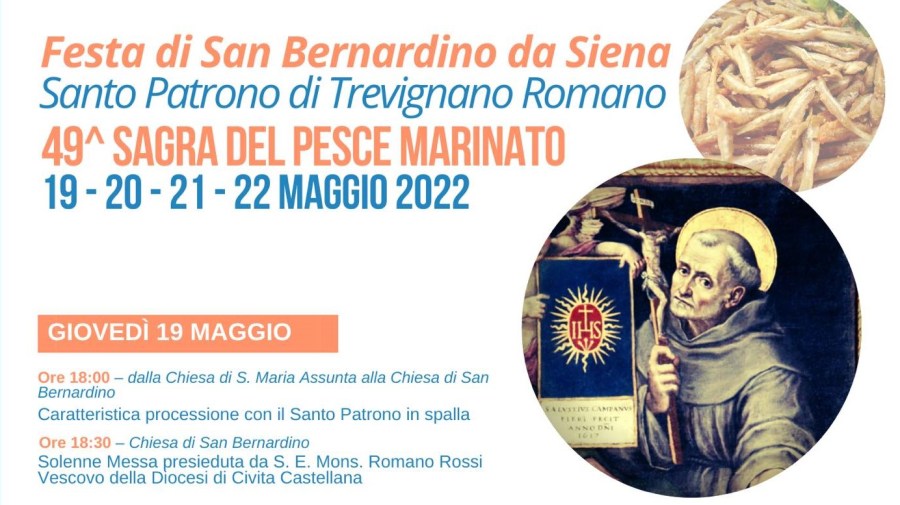
These days Italians remember Bernardino on his feast day for his somewhat cheerier acts. In Trevignano Romano (near Rome), locals have inherited a recipe for preserving fish directly from the saint himself. According to the tale, while assisting the frightened people of Trevignano in the hours before an imminent Saracen invasion, Bernardino told the local fishermen to launch their nets. The expected attack did not occur, and what’s more the fishermen pulled in such an astounding catch it was deemed a miracle, now celebrated annually with the sagra del pesce marinato, or marinated fish festival.

For the festival, fish such as pike, perch, tench, common rudd, and eel are prepared according to the recipe created on that reputedly miraculous occasion. Once cleaned, the fish are cut into pieces, salted, floured, and fried in boiling oil. After resting overnight, the fish is layered into an earthenware container along with small amounts of sage, lemon, and rosemary. Finally, the fish is covered with vinegar and left to marinate for a few days.

pictured: a poster for the 2022 sagra di pesce marinato on occasion of Bernardino’s feast day in Trevignano Romano.

May Day

May Day is an ancient springtime festivity traditionally associated with abundance and rebirth, a moment in the seasonal cycle to celebrate the virtual explosion of life embodied in blooming flowers, lovers, and longer days.

European cultures have been observing May Day for millennia. From the Celtic Beltane and Germanic Walpurgishnacht to Last of April in parts of Scandinavia, the period of April 30-May 1 initiated a crucial phase in the natural cycle of the year and heralded the transition from spring to summer. (For the ancient Romans and others, February 1 was the first day of spring and May 1 the start of summer, which accounts for the term midsummer to describe the summer solstice festivities starting around June 21 and culminating with the Feast of John the Baptist on June 24.)

May Day lives on in various revived folk customs and re-enacted rites of pre-Christian Europe. Song and dance play a major role in these contemporary observances, in a manner reminiscent of other performative calendar customs aligned with the changing of seasons (wassailing, mumming, guising, trick-or-treating, and so on). In Italy, Calendimaggio (from the Latin 𝑐𝑎𝑙𝑒𝑛𝑑𝑎 𝑚𝑎𝑖𝑎, meaning calends of May), goes by other popular names that reflect this day’s strong association with song: 𝑐𝑎𝑛𝑡𝑎𝑚𝑎𝑔𝑔𝑖𝑜 or 𝑐𝑎𝑛𝑡𝑎𝑟𝑚𝑎𝑔𝑔𝑖𝑜, both related to the Italian word cantare, to sing. 

Head out to the Italian countryside today and you might spot troupes of flower-adorned musicians frolicking about, singing their auspicious, entertaining songs in exchange for offerings of eggs, wine, cakes and other sweets. These are the maggerini, or maggiaioli, the May Day singers who delight crowds with lively and symbolic 𝑚𝑎𝑔𝑔𝑖 𝑙𝑖𝑟𝑖𝑐𝑖 (a “maggio” in this context is a type of rhymed couplet), songs proclaiming the joys of the season and young love, always with a good dose of lyrical flair and wit.

As part of the customary farewell to winter darkness and winter habits, Italian women would clean out their larder stores on or around this day, in preparation for the summer bounty to come. Some rather tasty and inventive “pantry soups” derive from this tradition, recipes meant to make use of one’s stored goods. These include garmugia (Lucca), le virtù (Abruzzo), and the Sicilian specialty macco di fave, typically prepared on or around the feast of Saint Joseph (March 19).

This is day to rejoice in all the precious springtime favorites, like delicate wild asparagus, agretti, May wine infused with sweet woodruff, mint, fresh strawberries, women adorned with pretty flower wreaths and men in verdant leaves and branches. And thoughts of hope, change, and progress as we clear out the cupboards and set a pot on the fire and inhale the intoxicating joy a bouquet of aromatic flowering herbs brings.

image: John Collier’s “Queen Guinevere’s Maying” (1900)