The Provence Problem

August 2012 – Our final hours in Provence, and we’re spending them at the supermarchet. Having made peace with our French supermarket obsession, we park and head to the entrance like giddy children let loose in a grown-up candy store.

No turnoff sign for Templar chapels or Roman ruins will ever entice us so much as a billboard for our favorite chain supermarket, we now realize—the liberating effects of this epiphany discernable in our carefree yet purposeful gait. Just through the turnstiles, we part ways without so much as a glance at one another: he makes straight for the fromage de chèvre; I follow my nose to what is possibly my favorite spot in all of France: the aisles of pâtès, sauces, and espices.

I run my fingers over textured packaging, study labels and inspect seals, getting my bearings before the daunting selection. Really, how does one choose among six brands of black olive tapenade? Most expensive? Fanciest label? Simplicity of ingredients, surely? The wannabe gastronome in me is frustrated, and not for the first time do I sincerely regret my poor French language skills in the face of such crucial decisions. Very close to sweeping entire shelf-fuls of glass jars into my basket, I remember my list. Hastily written on the short drive from our chambre d’hote, it serves not so much to remind me of the items I seek—I could recite them in my sleep, frankly—but to keep me in check.  Without the list, I’d be hugging cheese wheels and fighting wine bottles for leg space the entire six-hour drive home to northeast Tuscany.

An hour later we regroup at our tacit rendezvous, the wall of heady pink temptation that is the vin rosé section. Before choosing wine, however, we must evaluate the contents of our respective baskets, considering our pocket books—we are at the end of an eight-day sojourn in the south of France, after all—as well as sheer volume. A glance at his basket tells me he’s exaggerated the chevrè and skimped on Roquefort. Looking closer, I see he’s not forgotten, bless him, my beloved cancoillotte de Franche-Comté à l’ail, a spreadable cow’s milk cheese made with garlic, silky when warmed and wonderful as a dip for crudités—but only two containers? He reminds me of our ice chest’s limited capacity. I curse our decision to not bring a back-up. “Didn’t we see ice chests on display near the entrance?” I ask. “Let’s just buy another.” Reason is slipping away from me, and only the coaxing reminder Provence will always be here restores my self-control. I forfeit a kilo of crème fraîche for three additional tubs of the tangy, viscous, manna-from-cheese-heaven stuff. We can now turn our attention to the wine. Another full hour passes before we get to the checkout line.

Rationing our culinary cache begins as soon as we reach the car, my mental red pen scratching loved-ones’ names off my souvenir list with startling ease. Hasty repacking and a firm shove is needed to force the ice chest closed, while crammed into every spare inch of car space is a tin, sachet, or bottle of some kind. The lot in its entirety—from lavender honey and herbes de Provence to Côte du Rhône wines, Alpine Crème de Violettes and Muscat de Beaumes de Venise, too many pâtès to count—represents a hefty portion of our vacation budget. If we get pulled over, my husband jokes as we head towards the highway, we’ve got plenty of booty for bribing a French policeman. I chuckle with him, but it’s a duplicitous gesture. I’d go to jail before relinquishing a single item.

The problem with Provence is its proximity. It’s always there, just a half-day’s drive from home. Occasionally my thoughts wander in that direction. Noticing my store of French foodstuffs running down, I take to sulking about my kitchen, begrudging my own backyard herbs their Tuscan extraction. We can just go, I think. Just get in the car and go. Irrational calculations follow—one day of driving, 50 euro in fuel, another 50 in highway tolls, maybe a night in a cheap hotel—and we could be back at the supermarchet come Saturday afternoon! One weekend. A few hundred euros. Doable. Not all extravagant. Not crazy.

Then reality returns with its host of accompaniments. Deadlines and day jobs. Doctor’s appointments. Dishes to wash. The demands of our ever-portlier feline charges. So no Saturday jaunt to the French market, not this weekend at least. I open a jar of moutarde de Dijon and peer inside. As I mull over the possibilities, wondering how best to utilize what little remains, recipes begin to flicker in my head like strobe lighting. I grab a spoon and carefully scrape the jar’s insides. Perhaps at the bottom I’ll find my muse.

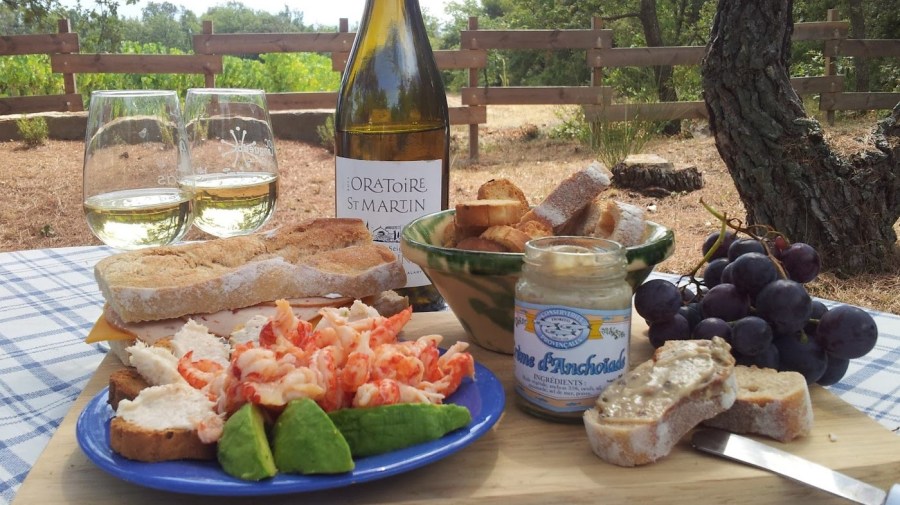
pictured: one of many problematic Provençal picnics
‘The Peaceful Invasion’: Us, Them, and Those In Between

Luigi Barzini’s The Italians opens with a chapter on Italy’s foreign visitors, from the pragmatics who land knowing precisely what to do and see, to the types rather easily, or willingly, derailed by the seductive charms of il bel paese.

Many types exist in between: students, artists, runaways, American nouveau riche in search of a guilt-free decadent lifestyle, in their minds unobjectionable only in Europe. Of the “vast majority of tourists, the millions driven by some unknown urge,” Barzini is frighteningly astute in his appraisals, perhaps mildly offensive at times, though never truly unkind; the “experienced” foreigners, on the other hand, those “who know why they come to Italy and what Italy is,” receive gentler treatment, but also less page space and insight. It is the crude novice, not the veteran Italophile, who provides the behavioral stuff worthy of examination.

A charming and self-assured introduction to a complicated subject, chapter one of The Italians is full of colorful, spot-on descriptions that still hold true today—it was published in 1964—never truer, in fact, than from May to September, months when disarmingly light-eyed souls sporting practical shoes and the unmistakable air of essere in vacanza arrive in even the remote Mugello countryside (my former home). It’s a localized invasion of sorts, in a region many Northern Europeans prefer to the Chianti, our sun being just as Tuscan, our goods and services less dear. For these few months, foreign-plated campers driven by Dutch, German and English traverse our green hills and dot our horizons; blond heads and faces tinged pink with wine and sun frequent our grocery stores and fill up our train cars; and brow-furrowing dialogue floats out of SUV windows at our gas stations. On any given summer day, tow-headed children can be seen splashing in agriturismo pools, blissfully ignored by their uber-relaxed, poolside parents.

Despite the heightened havoc they bring—they travel a lot, the barbarians!—I quite enjoy this breed of invader. Maybe because they are so at ease here, so unlike the dazed, desperately-seeking-David tourists who daily block my path to work in town. Maybe because often I eavesdrop on these linguistically-close folks and can relate: their comments on the great food, the ubiquitous rude waitresses, the horrific road quality, and so on, make me grin and shake my head in empathy.  In these moments I am, albeit very fleetingly, slightly less of a stranger in a strange land. It’s them, not us, right? our eyes say when they happen to meet. They do things oddly here, don’t they? I like watching them have their hedonic, casual way with Italy. And I am always somewhat envious watching them leave for their respective homelands, back to their cheaper and faster everything.

Often I feel more bonded with these short-term invaders than with the people among whom I’ve been living all these years. Our shared status as outsiders, together with our common cultural background, is a powerful pull, believe me, that even now as I write this influences my sympathies and judgments.

Take this couple seated near me on the train, probably retired, and certainly Northern given their once-blond hair turned a silken white no Italian has ever seen on dear old nonno.  They have already caught the attention of my fellow Italian commuters with their appearance and behavior. Now they are pulling sandwiches out of their travel pack, and I, in turn, am poised to defend them (well, in my mind at least) from the doubtful Italians looking on. Sandwiches? At this hour? These foreigners! they are thinking, I’d bet my life on it. Then they, the Italians, quickly dismiss that which is not worth comprehending, and return to their crosswords and cell phones. Italians have been living with invaders since the dawn of their history, after all. They know a foreign threat from mere folly.

I, who have lived with Italians for several years, see the couple differently. To me, their sandwich-eating is quaintly practical, while Italians consider it out of place.  Their mode of dress is too shabby for the Italian public, yet I appreciate the way their choice of clothes privileges comfort while maintaining hints of personal taste, those “garishly-coloured clothes” and “barbaric sandals” Barzini notes. (Italians don’t mean to be snobby; it’s in their makeup to view everything first and foremost in aesthetic terms. Something to do with being brought up among all that art). The woman wears her non-descript persona with ease, and I know the Italian women nearby suffer to see, and are confounded by, the way she has made peace with her pale, varicosed legs, the way the Italian sun has brought out an unappealing patchiness to her makeup-free complexion. Yet she smiles. She is intoxicated by Italy and (hopefully) unaware of the collective sizing up she will be subject to throughout this day. If she possesses even half of the cool confidence she exudes to my eye, however, she’ll hardly take notice.

You see, one of the thornier aspects of trying to make your home in another country is that you cannot shed the social and cultural layers that make you who you are, that formed and are still forming your beliefs. You can try to adapt to the country’s norms, marry one of its own, observe its holidays and ride its trains daily, but you will never fully take on its world view.  In great and small matters alike, the moments in which I realize this most clearly are those like the one described above, when trying to see others through Italian eyes.

Back to Barzini. Although “The Peaceful Invasion” seems a strictly one-sided assessment, much of its genius derives from what Barzini reveals about Italians, too, via his examinations of others.  Understand how we (Italians) view them (foreigners), and you (reader) learn about both groups, surely the rationale for opening a book that is in essence a treatise on the Italian character with a chapter dedicated to foreigners. But could Barzini, writing almost fifty years ago, have known that one day people like me would be reading his descriptions of people like them–and would feel such a division of loyalties? That his observations would enlighten, yes, but also affirm the inevitability of us and them to an altogether unpeaceful effect? Especially for those of us inhabiting the murky in-between.