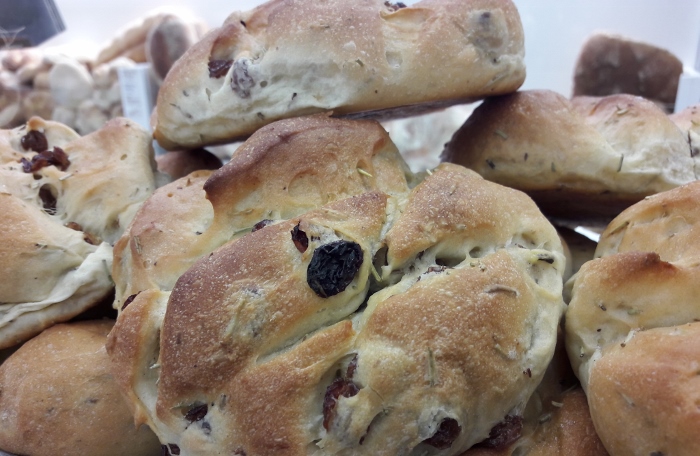
Take an early morning stroll through Florence on Holy Thursday and you’ll likely come across pan di ramerino—soft, round buns made with zibbibo raisins and rosemary—the traditional baked good to enjoy on giovedì santo.
More or less the Italian version of the hot cross bun, pan di ramerino can be found throughout much of the year, yet remains highly associated with Holy Week and Holy Thursday in particular, when area parish priests visit area bakeries to bless the buns.
In addition to the obvious symbolism of the cross, the ramerino (rosemary in Tuscan dialect) used in the preparation of these buns recalls the aromatic oils applied to the body of Jesus Christ on the cross (much like the traditional Roman focaccia made with fennel seeds, also prepared this time of year). Milk and eggs render the buns soft and light, transforming the bread from one that would otherwise have been “lean” to one fitting the close of the Lenten fast and the transition to the celebratory Easter period.
pictured above: pan di ramerino at a Florentine bakery
Agatha of Sicily is an early Christian martyr and one of the most highly venerated virgin saints in Catholicism, especially in Catania and Palermo, where elaborate festivals take place on February 5, her feast day.
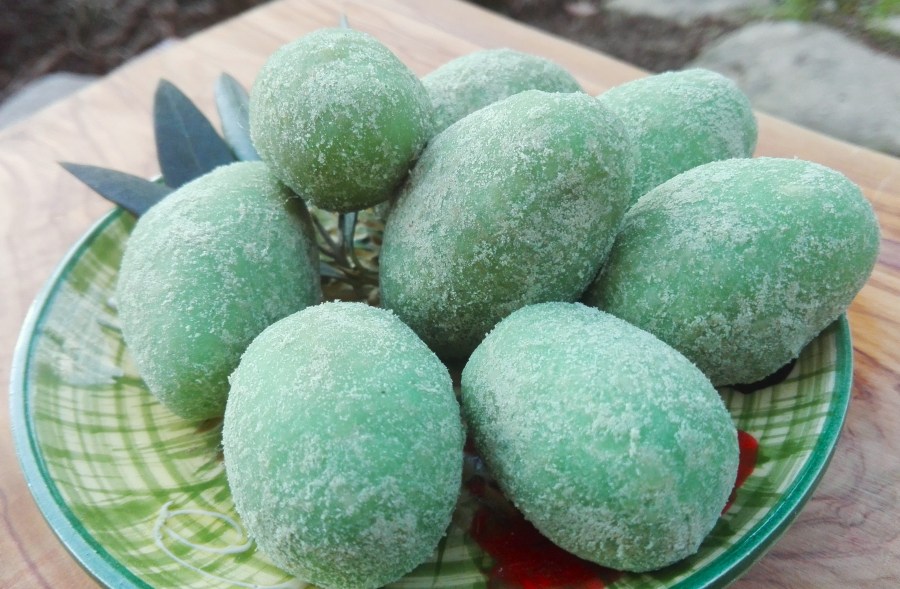
Agatha celebrations include elaborate, costumed rites, processions, chanting and singing, and feasting (of course). Today Southern Italians will honor Agatha with minne di sant’agata—pretty, oddly anatomically correct cakes shaped and decorated to looked like breasts, Agatha’s attribute, as her various tortures included having her breasts cut off. Thankfully, the narrative of this recipe for olivette di sant’agata, or Agatha’s olives, is less harrowing than that associated with her brutal martyrdom.
One of many stories about the saint recounts an episode involving olives: fleeing the soldiers of Quinctianus—a Roman proconsul who, failing to win the young virgin’s affections, had her tortured, sent to a brothel, and burnt at the stake—Agatha stopped to tie her shoe (as one does). While she knelt, a wild olive tree sprouted up before her, concealing Agatha from her pursuers and providing some needed nourishment. To mark this miraculous, temporary reprieve bestowed on Agatha, devotees also make sugary, marzipan-like olivette, colored with food dye and dusted with sugar.
(For more on tortured saints’ anatomical attributes in foodstuffs, read about Lucia and Lussekatter.)
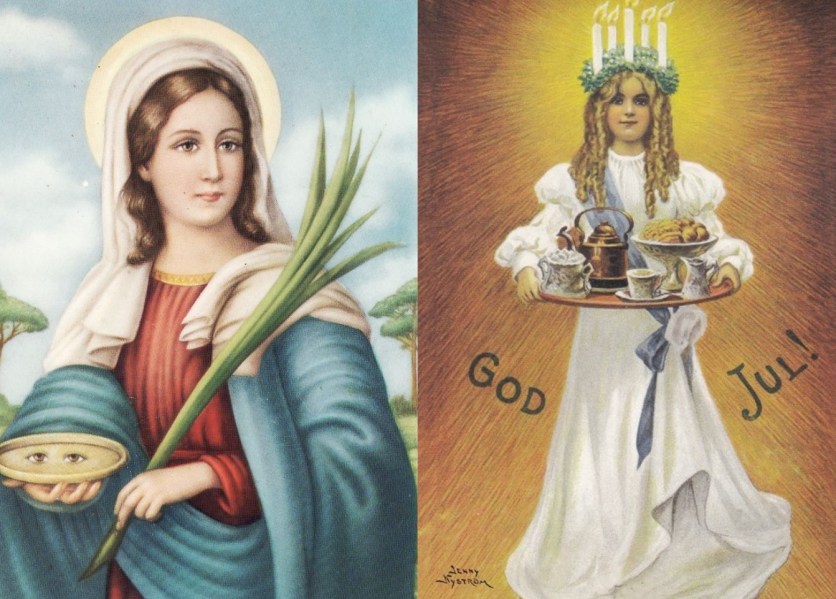
Across the numerous, often ambiguous and always fascinating stories of Lucia, the Sicilian virgin saint who rejected her suitor and gave her dowry to the poor, the one constant is her association with light, clarity, and vision.
As patron saint of sight—often depicted holding a platter with eyes, her attribute—Lucia protects her Catholic devotees from vision problems/eye diseases. And in Scandinavian countries where Lucia is highly venerated, Sweden especially, her feast day celebrations evoke ancient, heart-of-winter rites meant to illuminate the year’s longest nights. These Lucia festivities, known as Luciafirande, include processions of young women dressed in white who sing Lucia songs and carry candles in her honor.
In folkloristic terms, Lucia figures alongside other Saint Nicholas companions this time of year (indirectly, as she is not part of his processional entourage), characters like Krampus, the red-tongued devilish punisher of bad children, and La Befana, Italy’s frumpy, raggedy Christmas witch who flies around the world on Epiphany eve. Interestingly, Lucia shares qualities with both: depending on the version of the story, Lucia sometimes rides a broom (like La Befana); while in some Swedish traditions, young people dressed as Lucia go about scrounging for schnapps, not unlike their far-creepier counterparts in the Krampus procession.
In Scandinavian tradition, Lucia has a dark sister known as Lussi, a Nordic winter witch said to roam the skies on Lussinatt (“Lucy Night” or winter solstice, traditionally) punishing children and harming livestock. For some, pagan Lussi and Christian Lucia represent dark and light, respectively. Both names actually derive from the Latin word for light, yet for many the name Lussi in particular has become identified with Lucifer (“he who brings light”), leading to popular beliefs connecting her to the underworld and darkness. Lucia, on the other hand, remains consistently associated with whiteness and purity in her various (particularly Catholic) depictions.
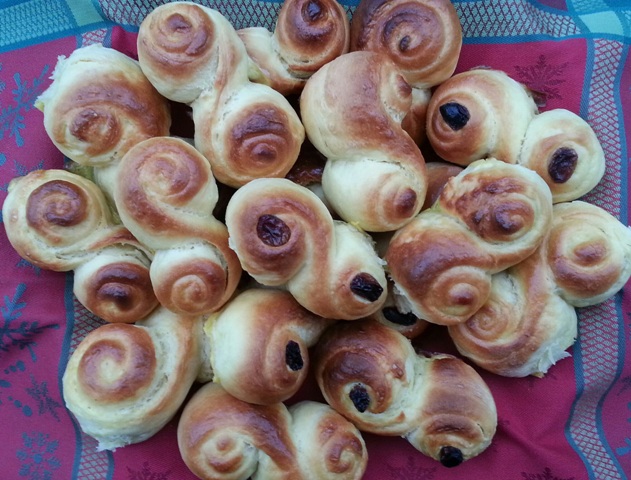
The definitive treat to enjoy during Lucia festivities are Lussekatter, or “Lucy cats”, saffron buns made with raisins meant to recall eyes.
pictured: my first and only attempt at homemade Lussekatter(2015)
 Writeous Folk