“They Even Eat Pig’s Blood!” Food, Fear & Friendship in “Welcome to the South”

Benvenuti al Sud (2010), an Italian remake of Dany Boon’s Bienvenue chez les Ch’tis, treats the same topic—the social prejudices and stereotypes rooted in a country’s historical north-south divide—with a nearly identical plot and style.

It follows Milanese family man Alberto, a fastidious middle-manager employed by the Italian postal service who, through a series of ridiculous blunders, is sent to work in a small coastal town near Naples. When transplanted to Italy, the socio-geo construct turns on a reversal of that in Boon’s film: whereas Southern France is considered a civilized, even coveted Mediterranean paradise in Bienvenue (Northern France suffering dreary climes and proximity to distasteful, barbaric ways), the reverse is true for Benvenuti.  Here, Milan, Turin, and their respective regions are the seats of civilization, industry, and progress, with Southern Italy the land of rough land laborers, poor manners, and unchecked criminality. 

Benvenuti relies heavily on reciprocal misperceptions, with an emphasis on northern prejudices toward southerners, to deliver the lion’s share of its comedic value. While preparing for his dreaded journey, Alberto decides to leave behind his watch and wedding ring, given the thieves he’s sure to encounter. He packs body armor, which he wears to bed on his first night in a southern home as a guest of his younger colleague and soon-to-be friend, Mattia. Later, in an attempt to assimilate, Alberto dramatically tosses his garbage out the window onto the street below, having heard from a fellow northerner that this is how southerners do things. And so on.

To establish Alberto’s thoroughly Milanese character, before his departure he is seen attending a meeting of the Illustre Accademia del Gorgonzola, a masonic-like brotherhood devoted to the quintessentially Milanese cheese.  (Italy is, in fact, home to many such food societies, complete with rituals shrouded in secrecy and strict hierarchies, modeled on the medieval confraternity.)  During the meeting, a brother warns Alberto about the various dangers in the South, from its shoddily built houses to its ubiquitous truck drivers. Most dangerous of all though is the food, a threat on par with the sickening pollution. The scene introduces a theme that will underpin the rest of the film: the power of food to both divide and unite culturally dissimilar groups. 

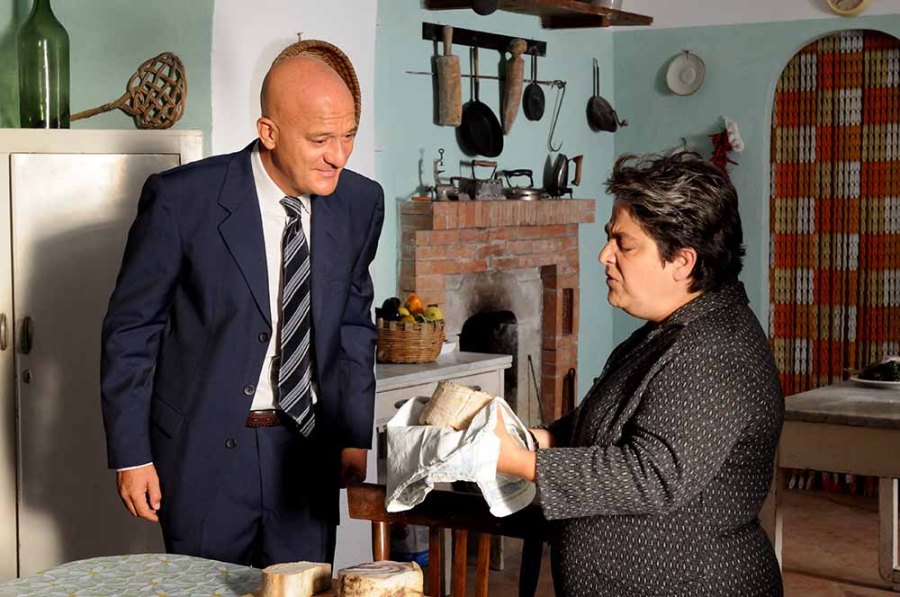
The first morning in his new home, Alberto breakfasts with Mattia and Mattia’s mother. Insisting on something light (coffee and dry toast), Alberto is instead offered the sweet egg cream zabaione and a homemade pastry filled with chocolate and pig’s blood. Underlying this humorous (albeit exaggerated) portrayal of contrasting eating styles is a graver topic, however—poverty versus abundance. In the historically poorer Italian South, abundance on the table in the form of richer homemade foods and larger portions is highly significant, while the abstemious, temperate foodways of the “civilized” North reflect a distinct historical privilege. Tellingly, Alberto’s own eating habits evolve alongside his developing friendships as he’s presented with opportunities that dissolve his former taste intolerance.

Charmed by the natural beauty of the area (filming took place in Castellabate, located south of Salerno amid Cilento National Park), friendships, and repeated invitations to dine and socialize with locals, Alberto progresses over the course of his two-year sojourn from a rigid, anxious man hindered more than he realizes by his trace xenophobia to a playful, relaxed man who is clearly happy and confident in his new element. In a scene indicative of his changing nature, he decides to join in the football match in the piazza just outside his post office—something he’d previously shunned as work-shy and inappropriate. Though a bit heavy-handed and predictable, and certainly guilty of perpetuating more than a few hackneyed comedy tropes, Benvenuti al Sud offers many pleasing moments in which our protagonist’s stodgy nature is enlivened, and arguably upgraded, through unlikely friendships. 

Benvenuti also achieves something audiences have come rather increasingly to expect (à la the current genre-blurring era of Netflix original series): a bridging of the gap between comic frivolous and tragic serious, facilitating edification for viewers in the guise of lighter-side entertainment. While Alberto’s errors in judgment evoke conventional comedic twinges of shame, his journey presents him with much loftier moments in which we see him thoughtfully reassessing his own bias. Ostensibly Benvenuti al Sud strives to make us laugh by exposing the folly of these specific Italian v. Italian stereotypes, and indeed it works hard to do this with its comedy. Yet in the dismantling of Alberto’s prejudices—prejudices that in Italian reality are very serious—we witness a character’s hopeful metamorphosis. 

The final scene of Benvenuti is refreshingly poignant, particularly within the otherwise cringey, hyper-cosmetic Italian comedy realm, yet at the same time feels somehow antithetical (ppov) to its own message. As the friends say their farewells, Alberto’s wife Silvia leans towards the visibly pregnant belly of her southern counterpart, Mattia’s now-wife Maria, to welcome il terroncello, or baby southerner, a diminutive derived from the infamous Italian pejorative, terrone. In turn, Maria responds, Ciao, polentona! referencing a common label for northerners, especially Milanese, for whom polenta is a staple. While the latter term draws from the ubiquitous use of food-rooted ethnic slurs to express racist ideology (English speakers will recognize terms like kraut, frog, and beaney, to name a few), it is a far slighter comment than the significant insult terrone, a word loaded with layers of systemic racism and classism, and the complex legacy that comes with that. 

Though delivered affectionately, the exchange continues the film’s relentless reliance on divisive stereotypes for humor, just at the moment we expect something more, something akin to a true rejection of such language, and I admit my dismay here the first time I watched Benvenuti. After subsequent viewings, however, I began to see the scene as a reminder of what has been at stake throughout—changing minds via comedy is a tall order, after all—as well as what has been achieved. Having upended at least a few of the damaging perceptions Benvenuti seeks to address, perhaps it has earned the right to conclude on its own comedic terms.

La Lumacata di San Giovanni: Roman Stewed Snails for the Summer Solstice

Of all the Italian Midsummer traditions still observed today, the Roman custom of eating snails on La Notte di San Giovanni, or St John’s Eve, remains one of the most fascinating and peculiar.

On the evening of June 23, in the piazzas and streets surrounding Rome’s San Giovanni in Laterano basilica, locals will dine on bowls of St John’s snails—a heavily symbolic dish, centuries in the making.

Ancient Romans were particularly fond of the snail, and not only on account of the flavorful meal that results from stewing snails in a sauce with herbs and spices (tomato sauce, many centuries later). For a people who regularly turned to divination practitioners for guidance on all manner of life concerns, the interpretation of symbols as nature presented them came easily. And in this seemingly simple creature, Romans discerned attributes teeming with meaning and potential.

Let’s start with the snail’s tentacles, commonly called horns. Leaving aside later Christianized perceptions of the horns as devil-esque, for Romans the eyes of the horns represented a different threat, the malocchio. Yet the horns were simultaneously perceived as the evil eye’s cosmic counteragent—the apotropaic sign of the horns (gesto della corna). In other words, these tiny physiological features embodied both the age-old curse (so menacing it required deliberate intervention) as well as the very means to shield against or undo its unwanted effects. 

Such analogies rendered the snail an unwitting embodiment of negativity, discord, and (to some extent) evil. To thwart misfortune, Romans would ritually consume snails at festivities held during the summer solstice period, as this was the time of year to honor the goddesses Fortuna (luck, fortune) and Concordia (harmony). To consume snails at these summer concordia or pax banquets was to dissolve discord, court forgiveness, and restore harmony to all one’s relationships.

Moreover, snail horns are an anatomical feature easily associated with ideas sexual in nature on account of their phallic likeness, and naturally Romans noticed this attribute as well. Across the Mediterranean, phallus symbols have functioned as a lucky charm for millennia; and in the ancient Greek and Roman worlds, a phallic-shaped charm was a specific type of protection from the evil eye. An outgrowth of this is a contemporary popular belief in Italy that males who consume snails on St John’s Eve or feast day will safeguard against a wife’s infidelity. Here the eating of snail horns (le corna) functions like a kind of sympathetic magic, shielding men from being cuckolded (fare le corna).

Incidentally, in the Roman dialect, the words for snail, ciumaca or ciumachella, are also affectionate slang terms for una bella ragazza, or pretty girl. And this Roman proverb speaks rather indisputably to the link between snails and courting:  Regazze da bacià e ciumache da magnà non ponno mai sazià (“One can never have enough girls to kiss nor snails to eat”).

By the Middle Ages, the summer solstice cycle of pagan rites and festivities had been subsumed by the cult of John the Baptist, whose nativity is celebrated June 24. In this later context, the Christian legend of the Baptist’s beheading further informed Roman beliefs and practices on what was now known as La Notte delle Streghe, or Night of the Witches. Seeking to avert perceived supernatural evils—namely witches believed to fly over Rome on their way to the Benevento coven on this night, in particular Salome and Herodias—Romans would flock to the Baptist’s namesake church.

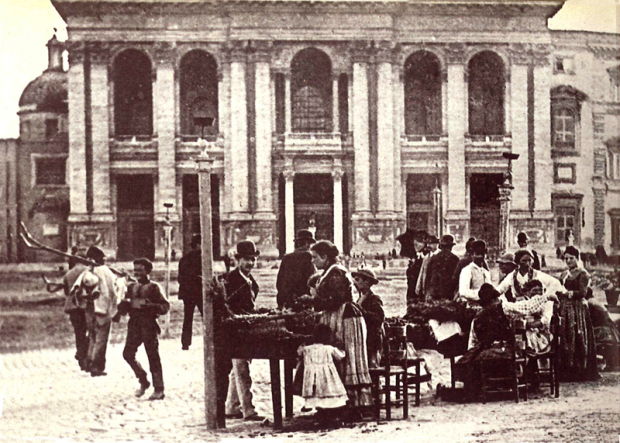
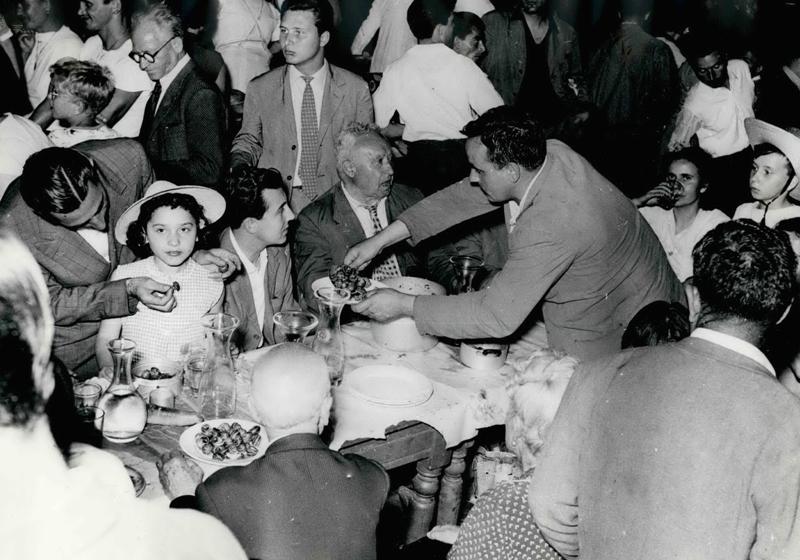
These public gatherings saw dancing, singing, and feasting (see the image above). Families would purchase baskets of snails brought in by peasants from the surrounding countryside (often vineyards), reflecting their ancestors’ belief in the snail’s auspicious potential. Indeed, the feast functioned as a communal apotropaic act, as conveyed in the saying: Per ogni corna di lumaca la notte di San Giovanni una sventura è scongiurata (roughly, “For every snail horn consumed on St John’s Eve, a misfortune is averted”). And the remnants of this heady historical hodgepodge of faith, superstition, and festivity live on in feasting events (sagre in Italian) that Romans call la lumacata di San Giovanni, feasts of St John’s snails stewed in tomato sauce, garlic, and herbs.

Today neopagans continue to experience Midsummer as a significant moment in the wheel of the year, a time to harvest all the magical energies this night releases—to seek healing and protection, to form life bonds and cement pacts, and to restore communal harmony. Hence the attendant mating rituals seen this time of year, such as marriage, handfasting, and bonfire leaping (not to mention fascinating health-restoring and beautifying rituals like l’Acqua di San Giovanni). At the core of these rituals is an enduring reverence for nature—plants, water, fire, sunlight and moonlight—believed to be at their most powerful on this sacred night.

Roman snail feast, 1955
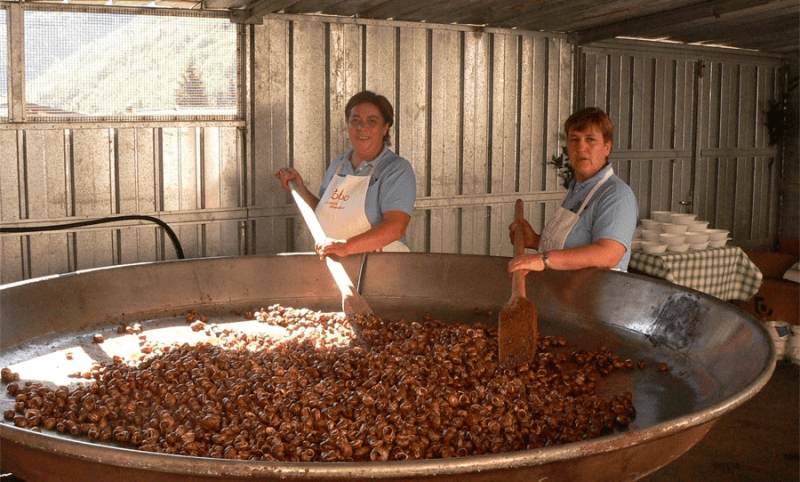
a ‘lumacata’ in the making, Lazio
snail vendors in piazza San Giovanni, Rome 1890

La Festa di San Giuseppe

It’s nearly impossible to overstate the significance of Giuseppe, foster father of Christ and patron saint of fathers, who functions as a symbolic paternal figure for Italians and whose feast day is, not by coincidence, la festa del papà.

Marked by abundance and giving, Saint Joseph’s Day is a categorically food-focused celebration of spring’s bounty. In countless communities throughout southern Italy and Sicily, the days leading up to March 19 see an ambitious and communal food-making endeavor, resulting in banquets so lavish and plentiful they seem to mock the very idea of hunger, if not vanquish it outright for the remainder of the year. No matter how many hungry guests gather round one’s table on San Giuseppe, there must always be leftovers to give to neighbors or homeless people.

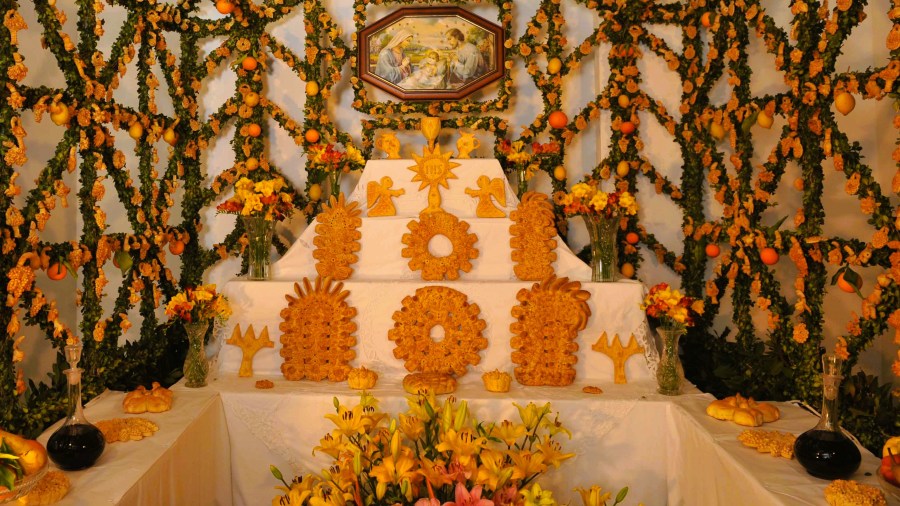
At the center of the feast is the Saint Joseph’s altar or table, upon which this mountain of food will be arranged. Nothing is placed on the table by chance; every item embodies some emblematic association or auspicious end. Bread takes center stage, as the most perfect expression of man’s toils transformed into sustenance, and recalling as well the ancient Roman grain festivals once observed during the winter-spring transitional period. Sweets, particularly fried and cream-filled pastries, mean a temporary reprieve from fasting and abstinence during Lent. Flowers, asparagus, wild fennel, and fava beans laid around the table speak to springtime’s imminent return, while lemons, oranges, and wine represent the fruit of the preceding season’s labors. Fish-based dishes symbolize Christ, and meat is usually absent from the table.

The countless fascinating food rituals surrounding this holiday derive from both ancient pagan and early Christian customs. In more recent centuries, thanks to Italian immigration, San Giuseppe festivities have taken root in other parts of the world—namely America, where Italian-American communities celebrate the saint with large, potluck-like events. Here are some of the Italian foods and lore associated with this significant feast day.

Fava beans. Several spring vegetables are linked to Joseph’s feast day, yet none so strongly as the fava bean, or broad bean. According to legend, a group of drought-stricken Sicilian farmers faced starvation until the saint intervened on their behalf, bringing about a miraculous crop of fava beans. This otherwise lowly legume has since come to represent Joseph’s generosity and benevolence, and in honor of him fava beans will be placed around the table or cooked in various dishes. Moreover, the fava bean has earned a lucky charm status among Catholics, some of whom will attend mass with a fava bean in their pocket on the day.

Maccù di San Giuseppe. Perhaps no dish embodies the transitional nature of this holiday so well as the stew known as maccù di San Giuseppe. As the move from one season to the next is often characterized by purging and cleaning rituals, the customary emptying of the pantry around the equinox is said to account for this many-ingredient concoction. All the items of last season’s harvest—dried beans, peas, lentils, chestnuts—are tossed into the pot along with fresh greens, wild fennel and fava beans (of course). In making maccù di San Giuseppe, Italians at once honor the saint and ready the pantry for the spring-summer bounty to come.

Focaccia di San Giuseppe. In Puglia, a special kind of focaccia is made in honor of Giuseppe, one whose unique combination of ingredients reflects the local taste preference for things agrodolce, or sweet and sour. Anchovy, young white onions, and raisins are added to a focaccia dough with a high olive oil content, which is then rolled into a spiral shape and baked. The bread likely owes its affiliation with the saint to the type of onions used, harvested this time of year before the onion bulb is fully formed and the stalk is very tender and flavorful.

pictured: a Saint Joseph’s altar in Salemi, Sicily featuring a stunning array of homemade votive breads