La Festa di San Marco

Mark the Evangelist aka San Marco holds special significance for Venetians, as patron of the city and for whom the principal square and basilica housing his relics are named, alongside countless other centuries-old traditions and honors.

Venetians observe la festa di San Marco with the (almost compulsory) eating a plate of rice and peas, or risi e bisi in Venetian. Tales about this dish are plentiful indeed. In the Republic period, come Saint Mark’s day, risi e bisi was invariably served to the Doge. It’s also said that a true dish of risi e bisi must contain more peas than rice, or at least equal amounts of the two. Anecdotes aside, this famously Venetian dish, often described as half risotto, half soup, is arguably connected more to Mark’s symbolic role in Venetian civic history than to Catholic observance. Its continued popularity reflects both the importance of rice production in the Veneto region and the ready supply of fresh peas in April, the latter thanks to the noted agricultural production of Venice’s smaller islands such as Sant’Erasmo, Vignole, and Torcello, islands that once functioned as fresh produce suppliers to the Venetian populace.

On the other side of the Italian peninsula, in the Nuoro area of Sardinia, the people of the small town Lei honor San Marco with a religious procession to the rural country churches dedicated to him. Among the procession’s participants are local women carrying trays and baskets of small votive breads, pale in color and intricately decorated with flowers, garlands, birds, leaves, and more. These elaborate dainty breads, called cocoietas in the local dialect, are later blessed and dedicated to San Marco, considered protector of the fields.
La Festa di San Giorgio

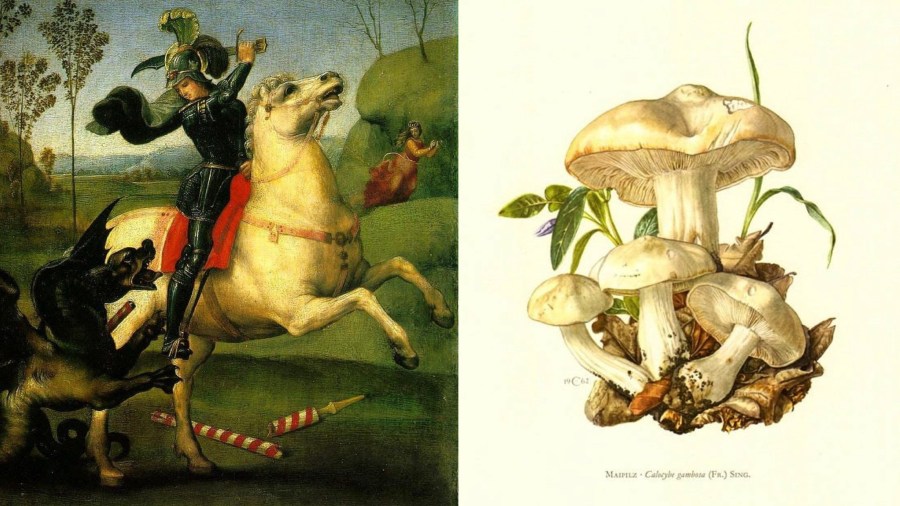
In Italy, San Giorgio is remembered less for his dragon-slayer status and more for the cute-as-a-button mushroom named after him, il fungo di san giorgio (aka prugnoli), traditionally said to appear on his feast day, April 23.

George is also patron saint of numerous Italian cities and villages. He is protector and patron of the Sienese militia, associated with Siena’s victory in the historic Battle of Montaperti of 1260. In Ferrara, George’s cult status derives from a medieval folk belief that a dragon inhabited the Po River. The Ferraresi honor George with a dedicated palio, and in so doing invoke the saint’s protection from the dangers of the Po and other nearby waterways (namely floods).

Throughout Italy today, all kinds of soups, breads, and biscuits bearing the name giorgio will be prepared, a custom that largely speaks to the availability of certain ingredients around his feast day. For example, bakeries in Lombardy will typically offer pan di meino, a sweet millet bread flavored with elderberry flowers, usually ready for gathering on or near April 23.

As with many calendar customs, Saint George’s day was a traditional ‘marker’ in the agrarian cycle of labor, harvest, and rest and/or feasting: on this day, dairy farmers would sign their annual milk supply contracts, securing their salaries for the year to come. To symbolically seal the deal, the pan di meino was dipped in a cup of decadent fresh cream and enjoyed by the parties involved.

Pan di Ramerino: Florentine Rosemary & Raisin Buns for Holy Thursday

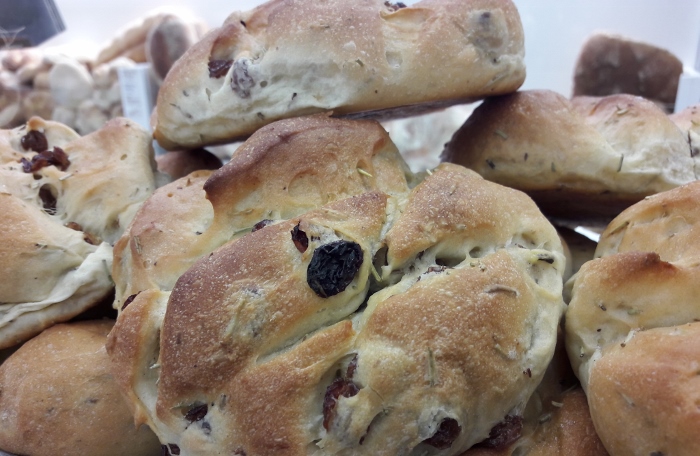
Take an early morning stroll through Florence on Holy Thursday and you’ll likely come across pan di ramerino—soft, round buns made with zibbibo raisins and rosemary—the traditional baked good to enjoy on giovedì santo.

More or less the Italian version of the hot cross bun, pan di ramerino can be found throughout much of the year, yet remains highly associated with Holy Week and Holy Thursday in particular, when area parish priests visit area bakeries to bless the buns.

In addition to the obvious symbolism of the cross, the ramerino (rosemary in Tuscan dialect) used in the preparation of these buns recalls the aromatic oils applied to the body of Jesus Christ on the cross (much like the traditional Roman focaccia made with fennel seeds, also prepared this time of year). Milk and eggs render the buns soft and light, transforming the bread from one that would otherwise have been “lean” to one fitting the close of the Lenten fast and the transition to the celebratory Easter period.

pictured above: pan di ramerino at a Florentine bakery