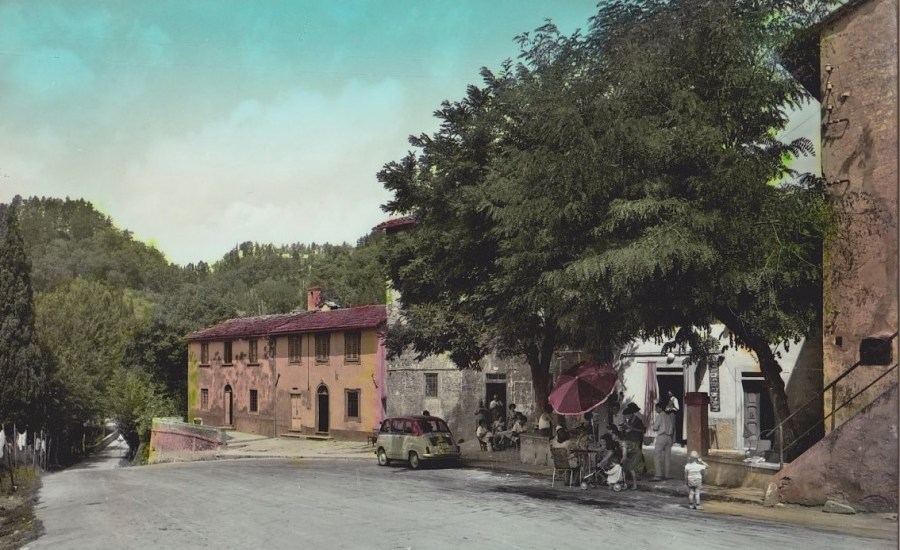
Grezzano is an old place. Not as old as some Italian villages, those claiming Roman or Etruscan foundations for instance, but getting up there in centuries. The parish church dates to 1086, established by the then-ruling Guidi family.
Intervening time has brought changes to this village, naturally—a rusty mailbox and a plexiglass-sheltered bus stop, an unassuming commercial concern called La Bottega—yet strip away these traces of modernity and what’s left is a 1,000-year-old cluster of farm houses, fields, and memories.
Every evening, weather permitting, Grezzano’s elderly gather in the piazza to people-watch and exchange information, mulling over topics they seem never to tire of: the weather and the harvest, husbandry and heart medications. Who among their silver-haired set ails this week. Children they’ve watched grow up here and move away, seeking opportunities and conveniences Grezzano can never provide. Grandchildren, the mention of whose names causes dull eyes to glisten. A little before the dinner hour they begin to stir, to cautiously straighten up time-crooked spines, test their footing. The women linking arms for mutual support, the men relying on walking canes, they say their farewells and head back to their respective homes, the houses they were born in.
The old people of Grezzano remember World War II, and not from books or oral accounts, but first hand—true memories, deeply personal and, given their quickness of recall, still very immediate. They talk openly about the war years. The horrors and senselessness of that time notwithstanding, it remains a crucial reference point for them. And they understand—they must—the value of the living testimony they possess; that what they impart with a few spoken words is worth more than all the scribbles in all the books in my study. Some remember, in the days leading up to the Liberation of this part of Tuscany, a local partisan’s shooting of a German officer while he drank his morning coffee, right here in La Bottega’s courtyard; and how consequently some of Grezzano’s men were rounded up and held captive for three days while the Germans considered reprisal options. (Ultimately, no retaliation came for that shooting, and the prisoners were released—extraordinary under the circumstances). They remember air raids and taking cover in the woods during close-by battles. They heard the explosions as the bridges of Grezzano were blown up, a common tactic of retreating German forces as the Allies advanced northward.
They were young then, some very young indeed. They survived, but not without tremendous loss and suffering. In the years since, what’s come to pass in Grezzano must seem at once remarkable and banal to them: bridges rebuilt, forests planted, vineyards abandoned, shops closed, condos constructed, roads paved. And a populace dwindling; the post-war years population of 1,300 people is today around 500. It’s a demographic anecdote Italy knows well: places like Grezzano pepper the boot from ruffle to heel, towns whose population grows smaller, older, with each passing year. What will happen to Grezzano when these people are gone? What of the memories, the crumbling stone walls in need of repair? I suppose I know the answer. I just don’t like to think about it.
*****
My nightly commute from Florence is riddled with whimsical musings, mini-epiphanies that burst impishly on the scene then steal away just as quickly. Forty minutes staring out a train window can do that. Lately, those meddling thoughts have been along these lines: as the train progresses fitfully towards my home, what recedes behind me is a mirage, a mere shadow of the country I live in. I leave behind the suffocating piazzas and tired and arrive at what is, for me, the real Italy: Grezzano, where time has been neither kind nor cruel, does not quite stand still yet is in no hurry either. She’s not unlike an old woman, Grezzano, one whose pace has slowed but whose mind remains ever-quick, draped in a verdant shawl that shields against the elements and conceals an unsuspected vigor, a fortitude that comes with age. This is my Grezzano.
Morning. Driving will give you more freedom and flexibility to explore Grezzano and environs, but it’s not absolutely necessary. With a bit of planning, a bus-train-walking combo is viable. Where you can, stop often to have a look around, get your bearings. You’re a bit off the map up here in the Mugello, land of wild boar hunters, surreal green landscapes and sudden summer storms; and while it’s true you’re only an hour from Florence, that hour has carried you far from the stuff of the 21st century. You’re going to need provisions. Make a stop at Bar & Pizzeria Valeri in neighbor town Luco di Mugello, where proprietors Massimo and Stefania will gladly make you sandwiches to go (schiacciata con prosciutto crudo e pecorino—always a sure thing!). Grab some drinks and you’re set for the short trek to Grezzano, but not before exploring some local sites just across the street.
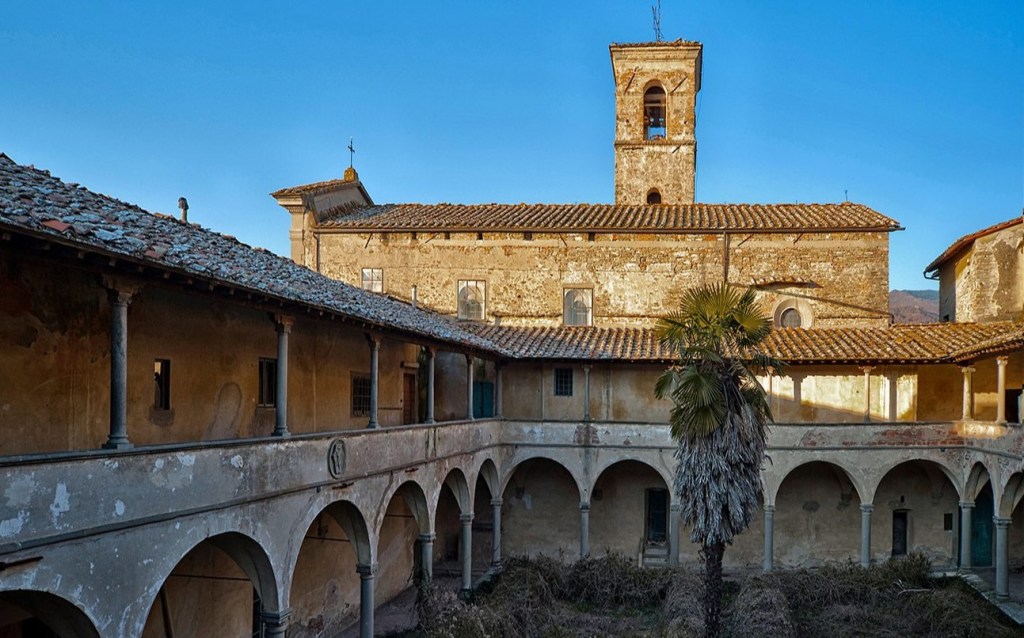
The Church of Saint Peter and its courtyard form part of a larger complex known as the Ex-Convent of Saint Peter of Luco di Mugello, which at the end of the 11th century became the seat of the first female Camaldolese monastic order. During Lorenzo de’ Medici’s time, sending female children here for instruction was a respectable (and fashionable) choice among Florentine nobles. Together, the nuns and the girls entrusted to them came to be known as the Countesses of Luco, on account of the young wards’ aristocratic status. The convent is currently closed to the public, though in recent years it was a hospital (my former sister-in-law was born there), and lately there’s talk of converting the structure into a hotel. Inside the church is a copy of Andrea del Sarto’s Pietà di Luco, an altarpiece commissioned by Abbess Caterina di Tedaldo della Casa in 1523 while del Sarto took refuge in Luco from plague-ridden Florence. The original lives in The Uffizi.
Exiting the courtyard through the vaulted portico, find the diminutive, Renaissance jewel of a chapel to your left on the corner, Santa Maria a Ripa. Constructed in 1583 at the request of Luco’s nuns, it was intended as a wedding chapel, one removed from the church of Saint Peter and the convent itself—thereby separating the rites of marriage from the rigorously chaste life of the cloistered “countesses.” If the door is open, step inside and observe the hexagonal structure and blue and yellow stained-glass eyelets in the dome. A quaint Marian legend associated with this church accounts for its epithet, la Divina Pastora, or holy shepherdess: a young girl, while tending her flock of sheep in a nearby field, wept for her and her family’s hunger, the larder at home being always bare. A woman appeared and took pity on her, telling her to go home and look in the larder. Finding it full of bread, the amazed shepherdess told her parents about the lady she’d met in the field, and the episode was declared a visitation by the Virgin Mary.
Now on to Grezzano, less than five minutes more by car, by foot about 25 minutes. After you get settled, stroll around Grezzano’s piazza, christened in 2009 Largo Rolando Lonari. Grezzano’s hometown hero, Lonari was a local boy who during WWII joined a partisan brigade based at Monte Giovi as a messenger. Captured, tortured and shot by Germans, 19-year-old Lonari was buried in Fiesole until years later when, at his family’s request, he was exhumed and laid to rest in Grezzano’s cemetery. Take a moment here to look around and imagine Grezzano in eras past. The bridge has been in place, in one form or other, for centuries. The area now comprising the bus stop, parking lot and children’s playground was once a vineyard. The paved street passing through the piazza was a much narrower dirt road. Spot the two roads leading away from the piazza. Take the hard left towards upper Grezzano, the Faini mill, and the Casa d’Erci museum.
About five minutes into your walk you’ll pass a roadside tabernacle, site of daily acts of homage in the form of fresh cut flowers and lit votives. A few more minutes on and you’ll see a sign on the left that reads Antico Mulino Faini. This fully operational flour mill dates to the 15th century, and since the late 1700s has been run by the Faini family—a familiar surname in Grezzano and Luco—who in 2001 opened the mill as a museum. Inside you can see the tools of ancient flour-making, including the original working turbine and millstones. The Faini mill has very limited public opening hours, Sundays 3pm to 7pm in summer, so if you find yourself in Grezzano on any other day, still take a few minutes to approach the mill structure and have a look at the photos on display in the yard.
Continue following signs for the Casa d’Erci, a museum and didactic center dedicated to the “old peasant ways”of this area. A popular field trip destination in spring, Casa d’Erci is part working farm, part open air museum, and a good spot for getting to know local agrarian history, industries such as charcoal-making and apiculture. The main structure’s rooms include a granary, a threshing area, a smithy and a cobbler shop, as well as the more intimate rooms of a typical peasant home: kitchen, laundry room, cantina, documents archive, a play room, and a space for religious observance. Don’t miss the animal trapping and pest-control room. Here you’ll see some rather ingenious non-weaponry methods of animal-hunting; forbidden by landlords from traditional game hunting on their lands, peasants relied on alternatives like cages and birdlime traps. Before leaving the main structure, stop at the fountain in the little courtyard for some of the purest water you’ve ever tasted.
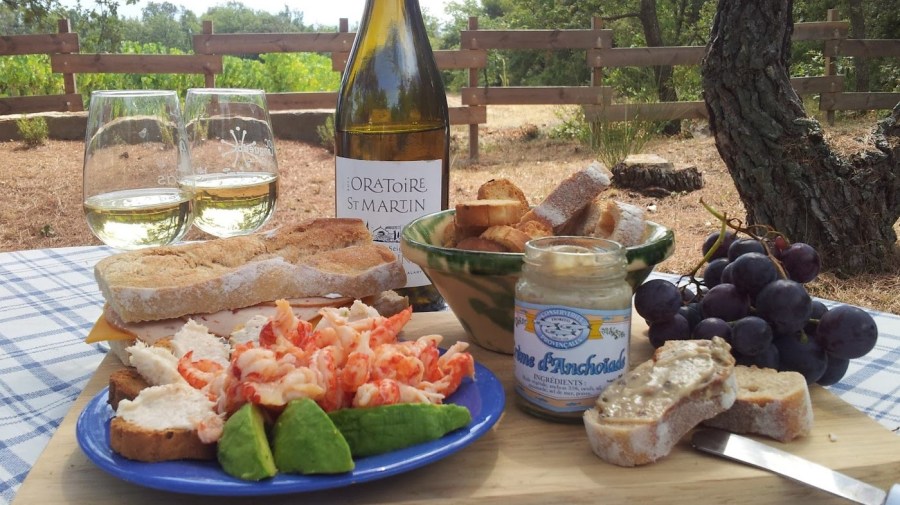
Lunchtime. Time to take out your sandwiches and make use of the Casa d’Erci picnic area, free of charge and empty of tourists, so unless you come on a field trip day (unlikely in full summer), you’ll have this cool green niche all to yourself. After your picnic, the walking trail that rings the picnic area makes for a perfect digestive stroll and will introduce you to Mugello flora. Afternoons, the hours when Grezzano shows her age, you could pass doing nothing at all. Residents are inside resting, and around 5pm will reappear refreshed and ready to recommence their various activities. You could take a nap here on the grass, read, and enjoy the shade. Or you could head back to Largo Lonari for a coffee at La Bottega. But since you’re here, if you’ve got the energy, I suggest you take a hike.
Fill up your water bottle back at the fountain, check your camera’s batteries and study the trail map located near the museum entrance—and you’re ready for this three-hour trek back into history. Head for the stretch called the Linea Gotica trail, named for the German line of defense that in post-Armistice Italy ran from Pesaro to the Carrara/Massa area north of Pisa, the Gothic Line. Synonymous with intense battles and partisan activity, the Gothic Line cut right through the mountains north of Grezzano where, in September 1944, the U.S. 5th Army, 85th Infantry Division broke through the Line after two days of fierce fighting with Wehrmacht infantry. The trail takes you into the heart of the fighting area at Mount Altuzzo, one of the mountains forming the Giogo Pass.

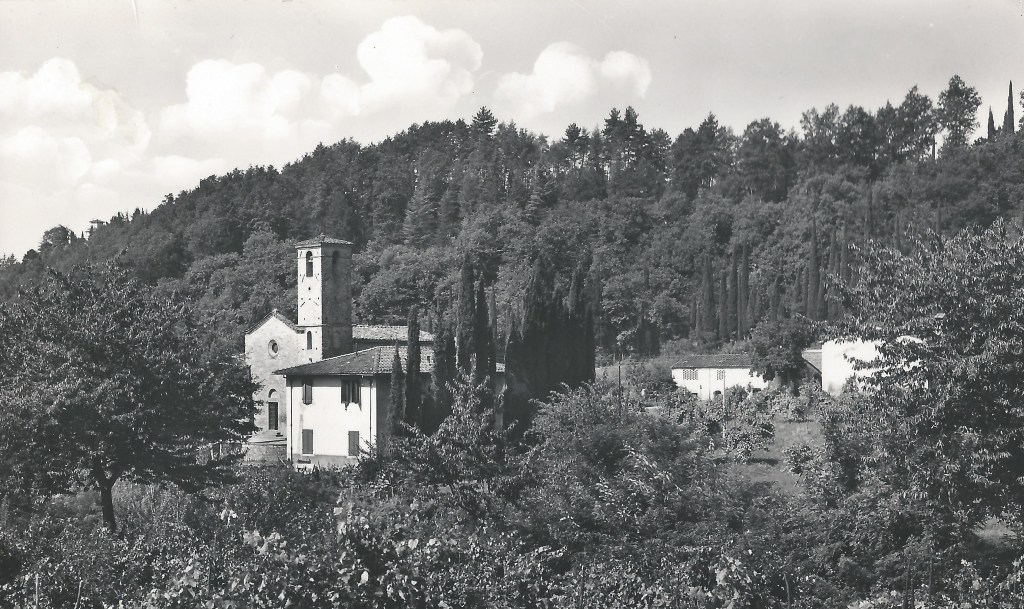
Back in the town, just across the bridge and to your right is the Church of Saint Stephen, Grezzano’s millenium-old parish church. Inside, a ciborium in pietra serena and a ceramic tabernacle are worth a look, but the true showpiece of this Romanesque structure is the outdoor mosaic above the entry. Like Saint Peter’s in Luco, the Church of Saint Stephen was home for a while to another Renaissance artwork destined, after a chance journey through various unintended hands, for the Uffizi: Rosso Fiorentino’s Madonna with Four Saints. Across the street is the Villino Le Scuole, Grezzano’s elementary school back when there were more children living here, now a private residence.
Dinner. A general-store-like enterprise by day, evenings and Sundays an eating establishment of some Tuscan renown, La Bottega is the closest Grezzano comes to “society”. It’s also where the insistent hunger you’ve developed on this day of exploring and hiking is about to be thoroughly satisfied, thanks to the talents of husband and wife owners Giancarlo and Enrica. Try Enrica’s homemade tortelli mugellani (potato-stuffed pasta), anything with porcini mushrooms, a bistecca fiorentina, or one of Giancarlo’s pizzas.
A restaurant and pizzeria since 1981, La Bottega’s history goes back more than a century. In the late 1800s, one of Giancarlo’s male ancestors married a local woman, whose family operated a general store just outside Grezzano proper. As her dowry, the young bride brought her family’s commercial licence to the match, and the newlyweds moved the shop to its current location in the piazza (check out the old photograph of the bride hanging near the pizza oven). For much of the 20th century, La Bottega was not a restaurant at all but a place to buy coal—coal-making being an established livelihood here in Grezzano—yet its location in the remote Mugello hills meant it offered refuge as well, a place for hunters and peasants to gather and rest. Hunters sometimes brought their kill. A small baker’s shop was next door. In time, La Bottega became a place to put bread and meat together, to pick up supplies, and to socialise. It remains much the same today, despite many notable transformations since that era.
After dinner. There’s nothing to do in Grezzano at night. You could take a digestif at one of La Bottega’s outside tables or call it a day and say goodnight to Grezzano. But if you’re at all tempted to stay longer in the area, there’ll be plenty to do come the dawn. The Mugello Circuit, Europe’s largest racing track (MotoGP, Ferrari Challenge) is just 10 minutes away. For the daring, the Aeroclub Volovelistico del Mugello offers 30-minute glider tours of the Mugello valley and can arrange English-speaking pilots. If you’ve caught the war history bug as I have, then don’t miss the Gotica Toscana research center and war museum in Ponzalla, housing a fascinating collection of Gothic Line battle weapons, soldier gear, and other wartime paraphernalia. In Scarperia, a medieval town founded by the Florentine Republic in the early 1300s, explore the old city center’s artisan knife-makers, a craft practiced here for generations.
*****
As happens many a night, tonight I came upon the old-timers club on my early evening walk. I’ve made a routine of passing by the piazza at this hour to eavesdrop, to glean the general sense of their chats before filling in the blanks with my history-book-stoked imagination. Sometimes I linger, trying by force of will to make my presence unobtrusive, yet knowing this can never be given the foreignness I wear like a mask, all the more evident in a town of this size. I was tempted to approach them, and while I’m sure they’d have gladly spoken to me, tonight it didn’t seem right. They have much to discuss these days: a bus driver was killed in a freakish accident in Grezzano recently, right here at our bridge; weather-wise, this month has been uncommonly rainy, altogether un-May-like, the effects of which will prove either ruinous or favorable, depending on one’s perspective, and one’s crop; and the recent earthquakes have put all Italians on edge, and will make for lively conversational fodder for weeks to come. So I kept on walking, pausing only the seconds required to say good evening.
On the way home I saw my favorite paesana, an old woman I am irrationally fond of considering I know nothing about her, save what my eyes and hearsay tell me. The grooves in her skin tell me she’s at least 85, probably closer to 90, years old. An abundance of silky white hair and her habit of walking the length of town—sporting heavy boots to cross icy roads in winter; in warmer weather, short woolen socks and bright pink sneakers—suggest robustness, independence, good genes. Her clear eyes convey acuity, her near-toothless smile that she is a peasant woman through-and-through, with no time or tolerance for vanity. I’ve been told it is she who makes the hundreds of hand-stuffed tortelli when Grezzano hosts the sagra del tortello, and her banter with those she meets in passing tells me she has always called Grezzano home. In her I see something of the manner in which I hope to grow into an old woman. Lucid, strong, at peace with her humble slice of the world. Come to think of it, that’s as probable a destiny as any I can imagine for myself. And as welcome.
 Writeous Folk