La Polentata delle Ceneri

An Italian polentata is a polenta festival similar to countless other food-centered events in Italy broadly referred to as sagre, and in this case an event that highlights polenta’s associations with Ash Wednesday observances and customs.

Long associated with the Lenten period on account of its “lean” quality—being a simple, frugal dish using no meat and relatively little fat (often none at all)—polenta is served on this day to mark the end of the “fat” celebrations that culminate on martedì grasso and the onset of customs such as fasting, penance, and atonement.

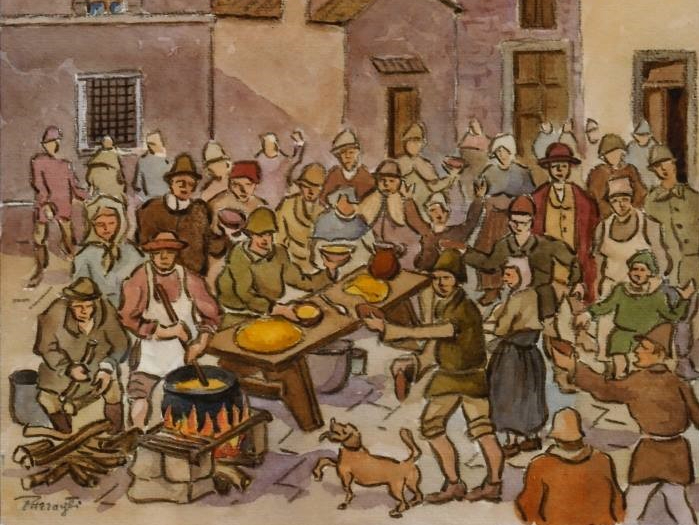
In Borgo San Lorenzo in northeast Tuscany, locals have been organizing a polentata on Ash Wednesday every year since 1800. It’s one of the longest-running folk events in the Mugello region, with a celebrated backstory that’s hard not to get a little enthusiastic about.  In 1799, following the French invasion of the Grand Duchy of Tuscany, a battle to push out French troops took place in the streets of Borgo (much of the Mugello and Casentino areas were influenced at that time by the resistance movement Viva Maria, centered in Arezzo, where resistance fighters took back their city after Napoleon invaded). After a furious battle in the streets around the Borgo San Lorenzo castle ended, and the dead had been buried, local housewives and peasant women set about cooking huge potfuls of polenta to feed the stricken survivors.

The following year the polentata took place on Ash Wednesday, becoming known as la polentata delle ceneri (cenere = ash), and has been held every year since in the town’s Piazza Garibaldi. According to Aldo Giovannini, an area journalist and historical image archivist who has published numerous books on the Mugello, the polentata was kept a humble affair, free of the concerns of social class—a testament to la libertà.

pictured: detail of Enrico Pazzagli’s “Watercolor Depicting One of the First Polentate, Early 1800s”
La Festa di San Martino

Today is the feast day of Martin of Tours, a 4th-century Roman soldier whose most legendary biographical anecdote tells of his halving his military cloak with his sword in a generous act to warm a freezing man encountered on the road.

After leaving the Roman forces and converting, Martin dedicated himself to the early Church, establishing some of the oldest monasteries in Gaul and later becoming Bishop of Tours. Martin gained astonishing popularly after his death and was highly venerated in the Middle Ages. In the many centuries since his life and works were documented by a contemporary, Martin’s patronage and feast day observances have vastly expanded from France to much of Europe and indeed all of the Christian world.

Interpretations of Martin’s attributes, the cloak and the sword, are somewhat antithetical. A soldier firstly, Martin is revered as patron of soldiers and is affiliated with many military groups and army corps. Yet we understand from his hagiography that Martin’s hatred of violence accounts for his renunciation of military life. As such, he is also patron of peace and peace movements, and moreover his feast day is both Armistice Day and Veterans Day. In many ways then, Martin is linked to both the laying down of arms and the very vehicle through which violence is committed (soldiering). And despite his concurrent associations with generosity and protection, Martin’s fervor for the newly legitimized Christian faith rendered him a rather zealous destroyer of Roman pagan sites of worship. While perhaps from a distance of 15+ centuries we can overlook such acts, common as they were among the church-building, evangelizing early Christians of Martin’s Day, still these biographical tidbits are not easy to reconcile with his reputed anti-violent character.

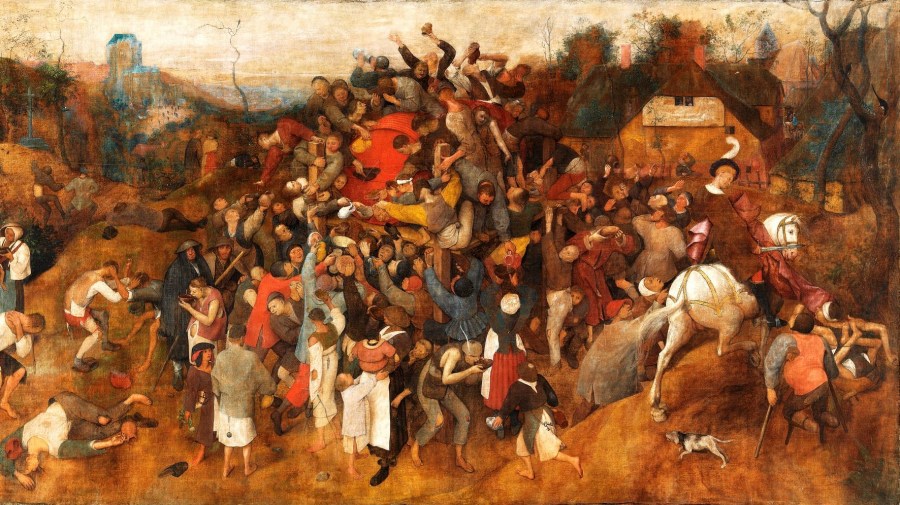
Since the Middle Ages, Saint Martin’s Day has been associated with the kind of exuberant festivities that frequently precede a fasting period (later, Advent). Falling at the end the harvest, specifically a point in the European agrarian cycle that sees annual livestock sales and slaughter (hence Martinmas beef and goose), Martin’s Day celebrations also happen just as young wines intended for immediate drinking arrive. In fact, in Italy la festa di San Martino coincides more or less with the arrival of vino novello (the less fussy cousin of Beaujolais nouveau), a link cemented in the popular Italian saying a San Martino ogni mosto diventa vino, meaning something like “on Saint Martin’s day, all must becomes wine” (the must has done fermenting). Note the drunken, spirited revelry depicted above in Bruegel’s The Wine of Saint Martin’s Day for an idea (perhaps exaggerated) of Martin festivities among land laborers enjoying the harvest’s new wine.

Throughout all of Europe, in both religious and secular manifestations, Saint Martin’s Day continues to represent a liminal period of seasonal, physical, and liturgical transitions, marked by the kind of feasting and merry-making that so often accompanies rituals of change or passage. Interestingly, although Martin’s Day is not as widely celebrated in Italy as in other European countries, Venetians celebrate Martinmas (which in other parts of Europe is also known as as “Old Halloween”) with customs similar to guising—children romp about town, banging pots and pans as they go from door to door, singing for candies and cakes much like Halloween trick-or-treaters. Praises are sung for those who give out treats, while curses and jibes are launched at the miserly. Watch some Venetian children doing just that in this San Martino “video postcard” from 2013. Other treats distributed to children on this day include San Martino cookies made in the shape of Martin on horseback or Martin holding his sword.

‘Fare San Michele’: Moving Day for the Métayer

Fare San Michele is an Italian idiom synonymous with moving day: in the mezzadria era, contracts between farm laborers and landowners expired on September 29, feast of Saint Michael, the day laborers moved on to other farms contracts.

A related saying, San Michele ribalto (“overturned” or “capsized”), describes any chaotic disorderly situation, or unexpected turn of events. This expression is linked to a tale of one such peasant family, for whom moving day ended disastrously with an overturned cart and their belongings scattered about and broken. The expression Fare San Martino has the same meaning, as November 11, the feast of Saint Martin, also saw the conclusion of seasonal farm work and the departure of laborers and their families.

pictured: Viesi, Roberto. “Alba di San Martino” (20th century)