Saint Agatha’s Olives

Agatha of Sicily is an early Christian martyr and one of the most highly venerated virgin saints in Catholicism, especially in Catania and Palermo, where elaborate festivals take place on February 5, her feast day.

Agatha celebrations include elaborate, costumed rites, processions, chanting and singing, and feasting (of course). Today Southern Italians will honor Agatha with minne di sant’agata—pretty, oddly anatomically correct cakes shaped and decorated to looked like breasts, Agatha’s attribute, as her various tortures included having her breasts cut off. Thankfully, the narrative of this recipe for olivette di sant’agata, or Agatha’s olives, is less harrowing than that associated with her brutal martyrdom.

One of many stories about the saint recounts an episode involving olives: fleeing the soldiers of Quinctianus—a Roman proconsul who, failing to win the young virgin’s affections, had her tortured, sent to a brothel, and burnt at the stake—Agatha stopped to tie her shoe (as one does). While she knelt, a wild olive tree sprouted up before her, concealing Agatha from her pursuers and providing some needed nourishment. To mark this miraculous, temporary reprieve bestowed on Agatha, devotees also make sugary, marzipan-like olivette, colored with food dye and dusted with sugar.

(For more on tortured saints’ anatomical attributes in foodstuffs, read about Lucia and Lussekatter.)
Lucia, Bearer of Light

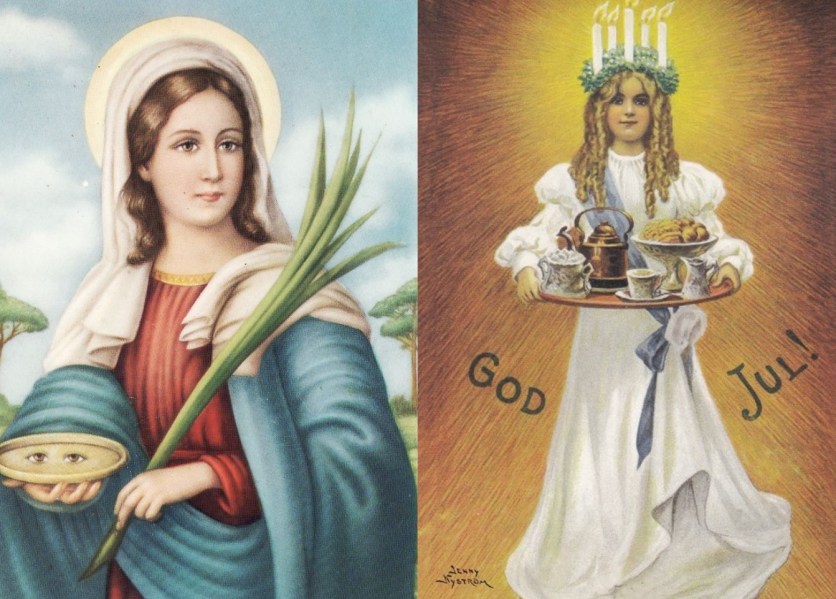
Across the numerous, often ambiguous and always fascinating stories of Lucia, the Sicilian virgin saint who rejected her suitor and gave her dowry to the poor, the one constant is her association with light, clarity, and vision.

As patron saint of sight—often depicted holding a platter with eyes, her attribute—Lucia protects her Catholic devotees from vision problems/eye diseases. And in Scandinavian countries where Lucia is highly venerated, Sweden especially, her feast day celebrations evoke ancient, heart-of-winter rites meant to illuminate the year’s longest nights. These Lucia festivities, known as Luciafirande, include processions of young women dressed in white who sing Lucia songs and carry candles in her honor.

In folkloristic terms, Lucia figures alongside other Saint Nicholas companions this time of year (indirectly, as she is not part of his processional entourage), characters like Krampus, the red-tongued devilish punisher of bad children, and La Befana, Italy’s frumpy, raggedy Christmas witch who flies around the world on Epiphany eve. Interestingly, Lucia shares qualities with both: depending on the version of the story, Lucia sometimes rides a broom (like La Befana); while in some Swedish traditions, young people dressed as Lucia go about scrounging for schnapps, not unlike their far-creepier counterparts in the Krampus procession.

In Scandinavian tradition, Lucia has a dark sister known as Lussi, a Nordic winter witch said to roam the skies on Lussinatt (“Lucy Night” or winter solstice, traditionally) punishing children and harming livestock. For some, pagan Lussi and Christian Lucia represent dark and light, respectively. Both names actually derive from the Latin word for light, yet for many the name Lussi in particular has become identified with Lucifer (“he who brings light”), leading to popular beliefs connecting her to the underworld and darkness. Lucia, on the other hand, remains consistently associated with whiteness and purity in her various (particularly Catholic) depictions.

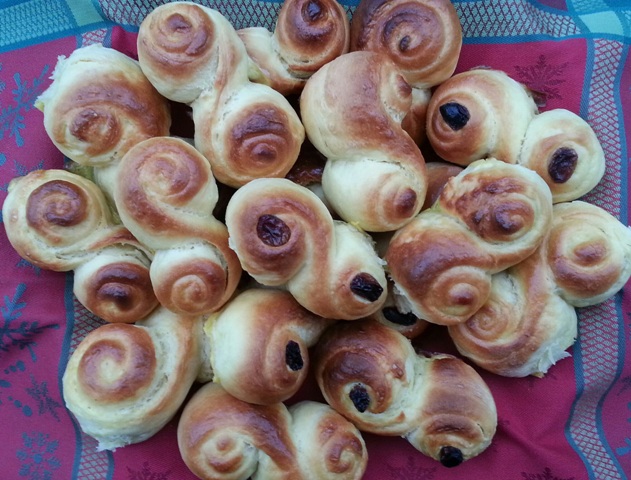
The definitive treat to enjoy during Lucia festivities are Lussekatter, or “Lucy cats”, saffron buns made with raisins meant to recall eyes. 

pictured: my first and only attempt at homemade Lussekatter (2015)

The Dark Winter Companions of Saint Nicholas

Saint Nicholas’s ‘dark’ companions, those whose function is to frighten or punish, often present as beastmen or half-beasts adorned in furs, horns, and claws—costumes in stark contrast to Nicholas’s benignly bearded appearance.

The tradition speaks (in part) to the role these figures play as bridges between deep winter pagan customs involving nature worship and observance of the cycle of light and dark—indeed, the frightful costumes worn are conceived partly as protection against the very real threats posed by winter’s long, dark nights—and later Christianized observances, such as Saint Nicholas processions and Santa Claus’s annual magical delivery of gifts. 

The fascinating figure of Belsnickel, for instance, combines this anthropomorphic beastliness with the ragged look of other Nicholas cohorts (like Italy’s la Befana, a Christmas witch who traditionally appears dressed in tatters). Draped in old furs and looking on the whole rather disheveled, Belsnickel may wear an animal mask of some kind, but he usually shows up to the Saint Nick party looking more man than beast. He’s described as mean and crotchety. He passes out candies and other treats to children, only after having tricked them in some way that involves his ever-present switch / whip. 

With his fellow Christmas cohorts, Belsnickel shares the dual task of delivering presents to good children and punishing bad children. His name derives from the diminutive of Nicholas and a German word that means “to beat severely”, yet an alternative version of his name, Pelznickel, refers to his fur-clad appearance (pelz = pelt). Interestingly, his name might also be related to Krishkinkle, aka Kris Kringle, though it seems the more widely confirmed origin of Kris Kringle is Cristkindle, German for “Christ child.”

Belsnickel is well traveled. He’s known in America, in particular in Pennsylvania, as discussed in this 2018 Pennsylvania Heritage piece that discusses Belsnickel’s evolution and journey from his German and Dutch roots to America with fascinating depth and detail.

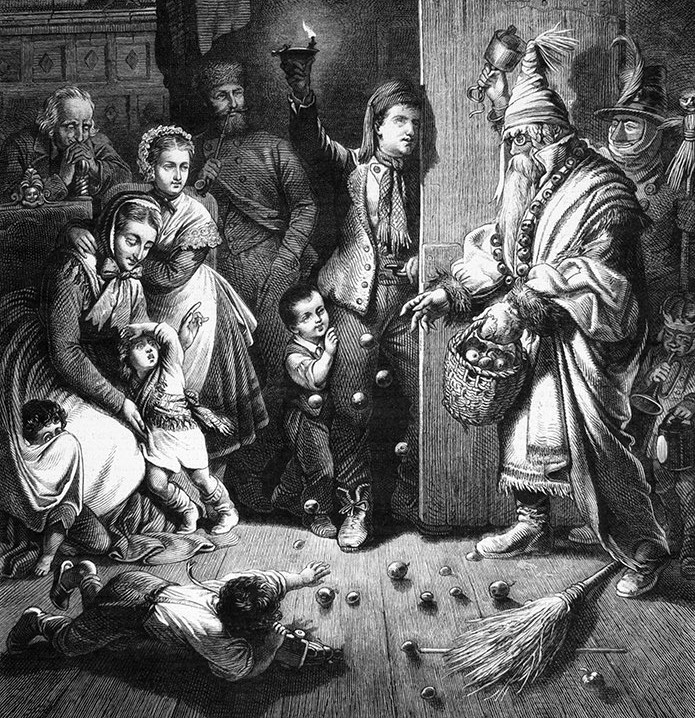
pictured: Swiss engraver Karl Janslin’s 1880 portrayal of Belsnickel at the threshold reflects his various functions: though distributing treats to reward the “good” children, he nonetheless has his whip at the ready, while the children hide in fear.