December Demons

December has become, for many, a time to reject the saccharine and materialistic version of Christmas and embrace instead the magical stillness of Midwinter’s long, dark nights.

For me, it is also a time to wonder at the fascinating cast of folkloristic figures who make their appearance this month—starting on Saint Nicholas’s Day (and eve) through Twelfth Night and the Feast of the Epiphany.

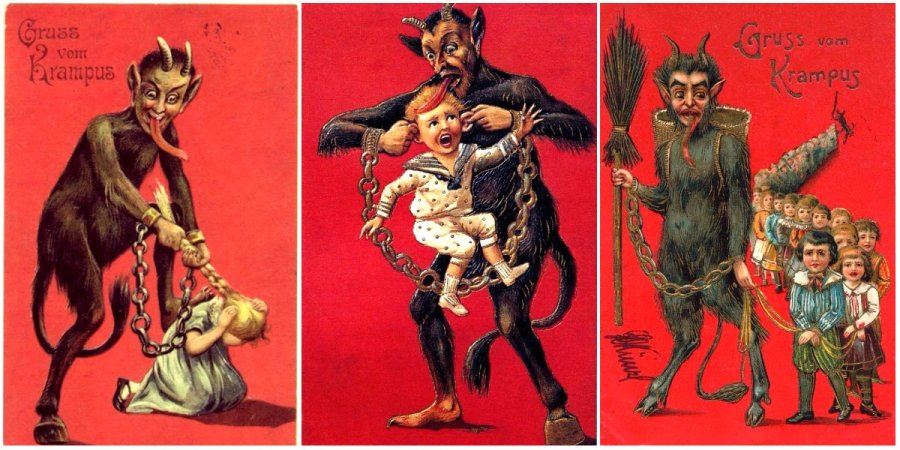
Among these characters, Krampus has lately taken center-stage as the most popular of Saint Nicholas’s sidekicks. In the past decade, in fact, Krampus has climbed from his relatively unknown status (outside his native Germanic/Nordic realms) to one of global Christmastime superstar, with books, articles, social media campaigns and even movies dedicated to him, while his annual parades, the Krampuslauf, grow evermore crowded, elaborate, and visually documented each year.

His primary function is counterpart to Saint Nicholas: Nicholas rewards, while Krampus punishes. His typical punishments come in the form of whipping and shoving children into his sack, to be carried off to his lair. Or maybe to hell. It depends on the version of the lore, really, and the naughtiness of the particular child. He can sometimes be placated with a offering of schnapps.

Many people question the appropriateness of Krampus, in particular his seemingly glorified acts of terrorizing children into being “good”. A counter-response I’ve frequently encountered asks if such a practice is any worse than bribing children into not being “naughty,” or exacting any type of specific behavior through the promise of excessive, superficial rewards (such as overpriced plastic crap and sugary foods).  

I think it’s important to see Krampus and his fearsome ilk as much more than winter “monsters”. He is a link, a sort of figurative bridge between the pre-Christian pagan beliefs and practices observed by peoples in Europe’s Northern and Alpine regions and the later figures who came to represent the Christianized version of Midwinter (Saint Nicholas, Santa Claus). Moreover, if we are paying attention, Krampus reminds us that our ancestors spent this time of year in connection with the natural world and in deep contemplation and acknowledgement of darkness and death. Celebrations took place, of course—think of the ancient Roman festival Saturnalia, for instance, from which we’ve inherited fascinating Midwinter concepts and practices such as misrule, disguise, inverted social roles and norms, etc—yet, broadly speaking, this time of year has turned into one of forced cheer and joy only relatively recently. 

Krampus’s surge in popularity may also represent a growing need to express our distaste with what Christmas has become, a way to purge oneself of antithetical ideas and feelings not permitted, even taboo, during this be merry or else season. In that sense, Krampus and his acts might be considered cathartic. Personally, I find his revival promising: a sign of increased interest in these fascinating forms of ancient deep winter observance and festivity.

image courtesy of Davide Bon
Paschal Baylón & Zabaglione

On May 17, the people of Naples venerate Paschal Baylón, a Spanish Franciscan who lived in the second half of the 16th century and canonized a century after his death in 1592.

As he likely never travelled to southern Italy, many attribute his popularity in Naples, where numerous streets, piazzas, and churches are named after him, to the significant cultural influences resulting from centuries of Spanish rule in the area. Baylón definitely spent time in Turin, however, where his association with “female” concerns took root; in addition to his patronage of pastry chefs, Baylón is protector of women and helper to women seeking husbands and it is here that his legendary role in the creation of the egg cream known as zabaglione (also spelled zabaione) comes into play.

While in Turin, Baylón is said to have advised women complaining of their husbands’ spent sexual desire to prepare a mixture of egg, cream, sugar, and wine. The recipe, apparently successful in stimulating the attentions of at least a few husbands, grew in popularity among Turinese women, and eventually spread to other parts of Italy. Meanwhile, its name morphed from San Bajon, the saint’s name in the Turinese dialect, to zabaglione.

Among the various competing versions of zabaglione’s origin story, a widely-held belief in its fortifying or tonic-like qualities has remained constant: beyond its reputed aphrodisiacal powers, zabaglione is also considered a beneficial nutritional boost for the weak and sickly. On his feast day, many southern Italians, mostly women, will remember Baylón by preparing zabaglione along with different types of pastries and cakes calling for an egg cream filling, while invoking the saint with a dedicated prayer: San Pasquale Baylonne protettore delle donne, fammi trovare marito, or “Saint Paschal, protector of women, help me find a husband.”

Gorse in Cornwall

cornwall gorse

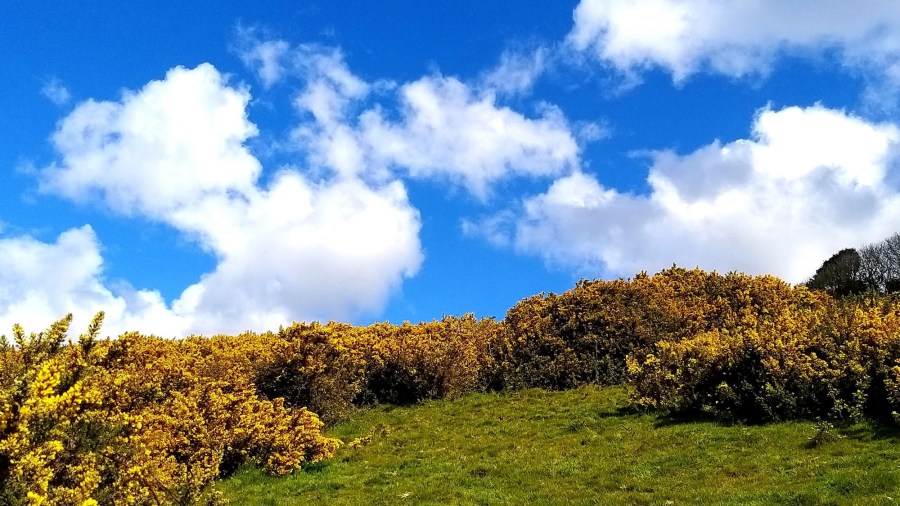
Gorse is a thorny evergreen shrub that thrives on Cornwall’s windswept moors and fields, bathing vast stretches of the Cornish landscape in cheery yellow for much of the year.

Also known as furze or whin, gorse plays an important role in area ecosystems, providing dense, protective cover for nesting birds. This abundant, resilient plant has been used traditionally for an array of purposes, from livestock fodder to dye-making and besoms, as a pest repellent for crops and even the ultimate clothes line (once latched on to its sharp, strong spines, fabrics are not easily blown away from gorse!). Long associated with fire, gorse is propagated through burning and is a high wildfire risk throughout the United Kingdom. Time ago gorse crofts were a vital source of firewood for Cornish peasants, its highly flammable qualities rendering it a valuable fuel.

Come the start-of-summer ritual observances around May Day, gorse appears alongside other May flowers in bundles attached to one’s front door or posts to ward off evil, thieves, or ill-wishers; and in Cornwall particularly locals might tie a sprig of gorse to the front door in exchange for treats from friends and neighbors. To some the national flower of Cornwall and for ages linked to Saint Piran, early Christian saint and patron of tin miners (and popularly recognized as patron saint of Cornwall, though he shares that status with at least two others), gorse represents one of those bridges between symbolic and literal I find so fascinating, connecting folkways, cultural identity, and the natural world through its many uses and associations.

Gathering gorse flowers can be a dangerous undertaking. Some wear gloves, but the best method is simply to pull the flower buds towards you to avoid being pricked by gorse’s small yet ferocious spines. So if you manage to gather some flowers sans bleeding, one way to make use of the flowers’ not-overly-floral composition and rich, almost nutty flavor reminiscent of coconut, is to make a cordial.  

Culture bites: Gorse is called ginestrone in Italian.  According to a Sicilian legend, the crackling noise of a burning gorse plant in the garden of Gethsemane attracted the attention of the Roman soldiers who captured him. As a result, the plant was cursed to always crackle and hiss when burnt.

Variations of a popular saying in Cornwall and elsewhere in the U.K. reflect the plant’s prolific bloom throughout most of the year: “kissing’s out of fashion when the gorse is out of blossom” or “when the gorse is not in flower, kissing’s out of fashion’, among others.  Kiss the year long, in other words.