
Purgatory Beans

Every Ash Wednesday, the town of Gradoli in Lazio hosts a peculiarly named event: the pranzo del purgatorio, begun in the 1300s by the Fratellanza del Purgatorio, one of countless confraternities in Italy dating to the medieval period.

The event unfolds throughout the town in various phases. Prior to the lunch, the confraternity members march through Gradoli soliciting “fat” donations like prosciutto and other cured meats, livestock, or even cash. Sellable items are then auctioned in the piazza, traditionally to fund Holy Mass for souls in purgatory and the Ash Wednesday lunch for the poor. The meal, intentionally magro (lean) to mark the start of the Lenten season, consists of fish from nearby Lake Bolsena and a special variety of stewed white beans, flavored simply with herbs and olive oil. These small, soft-skinned, no-soak beans have been associated with Gradoli’s purgatory brothers so long that they’ve come to be known simply as fagioli del purgatorio—purgatory beans.

In recent years, Gradoli’s pranzo del purgatorio has transformed into a massively popular sagra that hosts hundreds if not thousands of participants. In La Cucina delle Tuscia: Storie e Ricette, Italo Arieti notes that while the menu of fish and beans remains unchanged today, the event has apparently lost its former overt associations with penance and abstention and gained an atmosphere of festive abundance (reflected by portion sizes, for instance). Arieti also tells us that those who join the lunch are no longer obliged to continuously chant Viva le anime nel purgatorio! for the souls in purgatory.
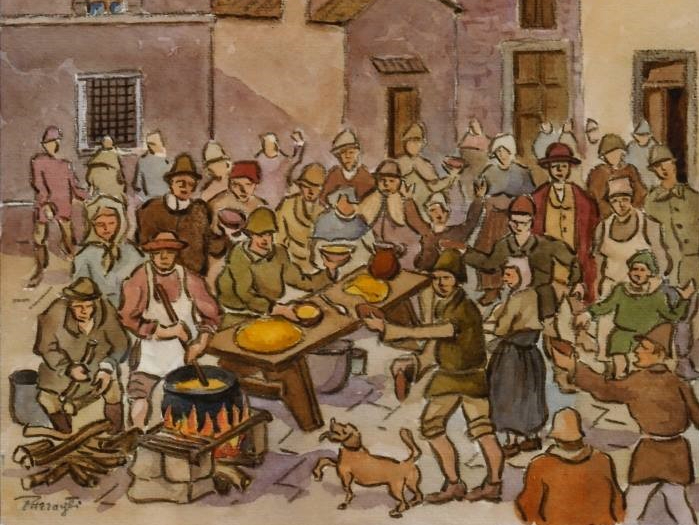
La Polentata delle Ceneri

An Italian polentata is a polenta festival similar to countless other food-centered events in Italy broadly referred to as sagre, and in this case an event that highlights polenta’s associations with Ash Wednesday observances and customs.

Long associated with the Lenten period on account of its “lean” quality—being a simple, frugal dish using no meat and relatively little fat (often none at all)—polenta is served on this day to mark the end of the “fat” celebrations that culminate on martedì grasso and the onset of customs such as fasting, penance, and atonement.

In Borgo San Lorenzo in northeast Tuscany, locals have been organizing a polentata on Ash Wednesday every year since 1800. It’s one of the longest-running folk events in the Mugello region, with a celebrated backstory that’s hard not to get a little enthusiastic about.  In 1799, following the French invasion of the Grand Duchy of Tuscany, a battle to push out French troops took place in the streets of Borgo (much of the Mugello and Casentino areas were influenced at that time by the resistance movement Viva Maria, centered in Arezzo, where resistance fighters took back their city after Napoleon invaded). After a furious battle in the streets around the Borgo San Lorenzo castle ended, and the dead had been buried, local housewives and peasant women set about cooking huge potfuls of polenta to feed the stricken survivors.

The following year the polentata took place on Ash Wednesday, becoming known as la polentata delle ceneri (cenere = ash), and has been held every year since in the town’s Piazza Garibaldi. According to Aldo Giovannini, an area journalist and historical image archivist who has published numerous books on the Mugello, the polentata was kept a humble affair, free of the concerns of social class—a testament to la libertà.

pictured: detail of Enrico Pazzagli’s “Watercolor Depicting One of the First Polentate, Early 1800s”