La Festa di San Giuseppe

It’s nearly impossible to overstate the significance of Giuseppe, foster father of Christ and patron saint of fathers, who functions as a symbolic paternal figure for Italians and whose feast day is, not by coincidence, la festa del papà.

Marked by abundance and giving, Saint Joseph’s Day is a categorically food-focused celebration of spring’s bounty. In countless communities throughout southern Italy and Sicily, the days leading up to March 19 see an ambitious and communal food-making endeavor, resulting in banquets so lavish and plentiful they seem to mock the very idea of hunger, if not vanquish it outright for the remainder of the year. No matter how many hungry guests gather round one’s table on San Giuseppe, there must always be leftovers to give to neighbors or homeless people.

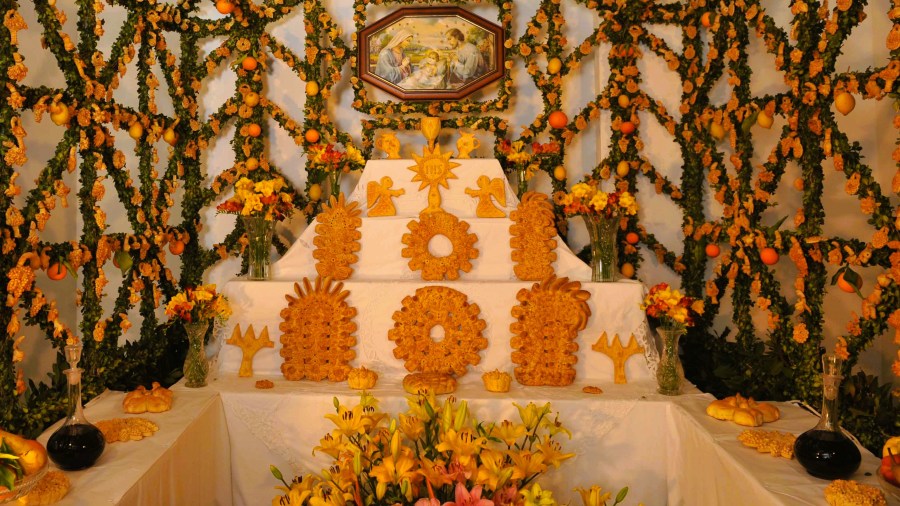
At the center of the feast is the Saint Joseph’s altar or table, upon which this mountain of food will be arranged. Nothing is placed on the table by chance; every item embodies some emblematic association or auspicious end. Bread takes center stage, as the most perfect expression of man’s toils transformed into sustenance, and recalling as well the ancient Roman grain festivals once observed during the winter-spring transitional period. Sweets, particularly fried and cream-filled pastries, mean a temporary reprieve from fasting and abstinence during Lent. Flowers, asparagus, wild fennel, and fava beans laid around the table speak to springtime’s imminent return, while lemons, oranges, and wine represent the fruit of the preceding season’s labors. Fish-based dishes symbolize Christ, and meat is usually absent from the table.

The countless fascinating food rituals surrounding this holiday derive from both ancient pagan and early Christian customs. In more recent centuries, thanks to Italian immigration, San Giuseppe festivities have taken root in other parts of the world—namely America, where Italian-American communities celebrate the saint with large, potluck-like events. Here are some of the Italian foods and lore associated with this significant feast day.

Fava beans. Several spring vegetables are linked to Joseph’s feast day, yet none so strongly as the fava bean, or broad bean. According to legend, a group of drought-stricken Sicilian farmers faced starvation until the saint intervened on their behalf, bringing about a miraculous crop of fava beans. This otherwise lowly legume has since come to represent Joseph’s generosity and benevolence, and in honor of him fava beans will be placed around the table or cooked in various dishes. Moreover, the fava bean has earned a lucky charm status among Catholics, some of whom will attend mass with a fava bean in their pocket on the day.

Maccù di San Giuseppe. Perhaps no dish embodies the transitional nature of this holiday so well as the stew known as maccù di San Giuseppe. As the move from one season to the next is often characterized by purging and cleaning rituals, the customary emptying of the pantry around the equinox is said to account for this many-ingredient concoction. All the items of last season’s harvest—dried beans, peas, lentils, chestnuts—are tossed into the pot along with fresh greens, wild fennel and fava beans (of course). In making maccù di San Giuseppe, Italians at once honor the saint and ready the pantry for the spring-summer bounty to come.

Focaccia di San Giuseppe. In Puglia, a special kind of focaccia is made in honor of Giuseppe, one whose unique combination of ingredients reflects the local taste preference for things agrodolce, or sweet and sour. Anchovy, young white onions, and raisins are added to a focaccia dough with a high olive oil content, which is then rolled into a spiral shape and baked. The bread likely owes its affiliation with the saint to the type of onions used, harvested this time of year before the onion bulb is fully formed and the stalk is very tender and flavorful.

pictured: a Saint Joseph’s altar in Salemi, Sicily featuring a stunning array of homemade votive breads
La Festa di San Martino

Today is the feast day of Martin of Tours, a 4th-century Roman soldier whose most legendary biographical anecdote tells of his halving his military cloak with his sword in a generous act to warm a freezing man encountered on the road.

After leaving the Roman forces and converting, Martin dedicated himself to the early Church, establishing some of the oldest monasteries in Gaul and later becoming Bishop of Tours. Martin gained astonishing popularly after his death and was highly venerated in the Middle Ages. In the many centuries since his life and works were documented by a contemporary, Martin’s patronage and feast day observances have vastly expanded from France to much of Europe and indeed all of the Christian world.

Interpretations of Martin’s attributes, the cloak and the sword, are somewhat antithetical. A soldier firstly, Martin is revered as patron of soldiers and is affiliated with many military groups and army corps. Yet we understand from his hagiography that Martin’s hatred of violence accounts for his renunciation of military life. As such, he is also patron of peace and peace movements, and moreover his feast day is both Armistice Day and Veterans Day. In many ways then, Martin is linked to both the laying down of arms and the very vehicle through which violence is committed (soldiering). And despite his concurrent associations with generosity and protection, Martin’s fervor for the newly legitimized Christian faith rendered him a rather zealous destroyer of Roman pagan sites of worship. While perhaps from a distance of 15+ centuries we can overlook such acts, common as they were among the church-building, evangelizing early Christians of Martin’s Day, still these biographical tidbits are not easy to reconcile with his reputed anti-violent character.

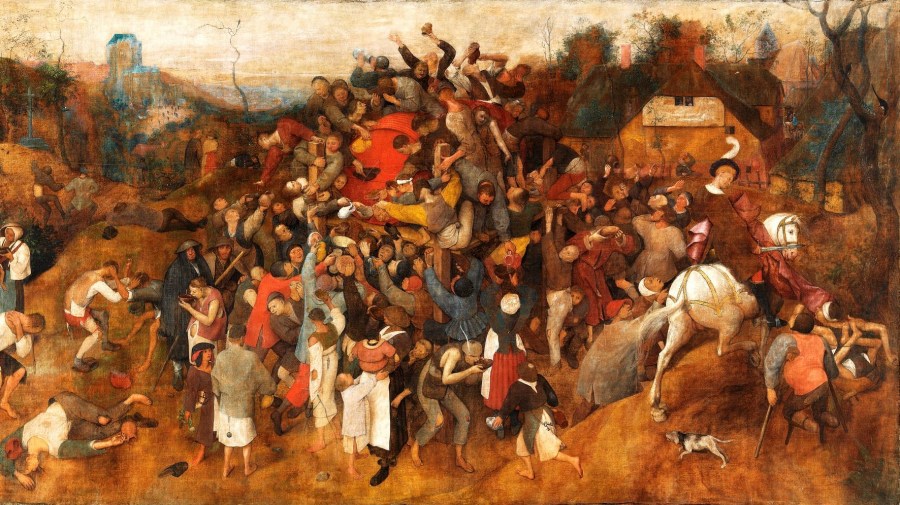
Since the Middle Ages, Saint Martin’s Day has been associated with the kind of exuberant festivities that frequently precede a fasting period (later, Advent). Falling at the end the harvest, specifically a point in the European agrarian cycle that sees annual livestock sales and slaughter (hence Martinmas beef and goose), Martin’s Day celebrations also happen just as young wines intended for immediate drinking arrive. In fact, in Italy la festa di San Martino coincides more or less with the arrival of vino novello (the less fussy cousin of Beaujolais nouveau), a link cemented in the popular Italian saying a San Martino ogni mosto diventa vino, meaning something like “on Saint Martin’s day, all must becomes wine” (the must has done fermenting). Note the drunken, spirited revelry depicted above in Bruegel’s The Wine of Saint Martin’s Day for an idea (perhaps exaggerated) of Martin festivities among land laborers enjoying the harvest’s new wine.

Throughout all of Europe, in both religious and secular manifestations, Saint Martin’s Day continues to represent a liminal period of seasonal, physical, and liturgical transitions, marked by the kind of feasting and merry-making that so often accompanies rituals of change or passage. Interestingly, although Martin’s Day is not as widely celebrated in Italy as in other European countries, Venetians celebrate Martinmas (which in other parts of Europe is also known as as “Old Halloween”) with customs similar to guising—children romp about town, banging pots and pans as they go from door to door, singing for candies and cakes much like Halloween trick-or-treaters. Praises are sung for those who give out treats, while curses and jibes are launched at the miserly. Watch some Venetian children doing just that in this San Martino “video postcard” from 2013. Other treats distributed to children on this day include San Martino cookies made in the shape of Martin on horseback or Martin holding his sword.

La Festa di San Lorenzo

On August 10, Italians celebrate San Lorenzo (Lawrence), patron of cooks, brewers, vintners, butchers, and bakers whose involvement in the then-considered heretical, anti-establishment early Christian religion led to his martyrdom.

It was on this day in year 258 AD that Roman officials sentenced Lorenzo to death, as punishment for his refusal to hand over various goods and treasures he oversaw as a church deacon (he distributed them to the poor instead). According to Christian lore, Lorenzo was placed on a gridiron to “cook” over hot coals, a tale that accounts for the saint’s now-legendary final words: “I’m well-done on this side. Turn me over!”

Not surprisingly, historians today dispute the factual accuracy of Lorenzo’s fantastical final hours; yet associations between the saint and his “death by grilling” remain strong. He is patron saint of barbecues and barbecuing, for instance, and cooks are known to invoke his protection in the kitchen, where burns by heat or fire are a very real threat. Italian kitchens commonly feature small Lorenzo statues, plaques, or holy cards. 

In Tuscany, San Lorenzo feasting usually means enjoying a traditional bistecca fiorentina (or other grilled meat). In this context, the role of the grill is central as the symbolic link to Lorenzo’s martyrdom on the gridiron.  Not everyone practices this fanciful (and perhaps gruesome!) manner of ritualistically recalling the death of the saint, however. In other parts of Italy, such as Naples and Bologna, the custom for some is to abstain from meat out of respect for the martyr, and thus at some San Lorenzo events, thick watermelon “steaks” are grilled in place of beefsteaks. 

Interestingly, both these foodstuffs fit neatly into the August calendar of customs: meat, especially a choice cut like the t-bone, was a rarity in the medieval and early modern peasant diet, and instead would appear on tables only during those significant cyclical festivities like Christmastide, Easter, or, as in this case, harvest time. In this sense, grilling up a decadent piece of meat to honor San Lorenzo, whose feast day coincides with the summer harvest and its attendant rituals of abundance, is fitting. At the same time, watermelons, too, are wonderfully abundant and refreshing in late-summer Italy. 

The summer grain harvest in Europe is a period whose feasting customs derive from pre-Christian August festivals such as Lammas, Lughnasadh, and Feriae Augusti. Rooted in the agrarian work cycle as well—August being both a time of reaping and a transitional period of shifting to other types of agricultural work after a festive “break”—holidays like San Lorenzo and Ferragosto / Feast of the Assumption (August 15) find expression in the popularity of bread, pasta, and other grain products. For example, Florentine bakers commemorate the saint by handing out plates of pasta con sugo and lasagna in Piazza San Lorenzo, a charitable act started centuries ago by their predecessors, members of l’Arte dei Fornai, or bakers guild, who chose Lorenzo as their patron. And almost everywhere in Italy, grilled bruschetta (or fettunta) will be part of the meal.

image: Larsson, Carl. “Harvesting the Rye” (1919).