San Bernardino’s Miraculous Catch

May 20 is the feast day of Bernardino of Siena, also known as Bernardine, an active Franciscan priest, well-known in early 15th-century Italy given his extensive travels around the peninsula.

While by today’s standards Bernardino could hardly be considered enlightened in his viewsβ€”his frequent and fiery sermons on the evils of usury, witchcraft, sodomy and more have earned him a (deserved) anti-Semitic, misogynistic and homophobic reputeβ€”during his lifetime they reflected contemporary religious concerns and beliefs held by many European Catholics.

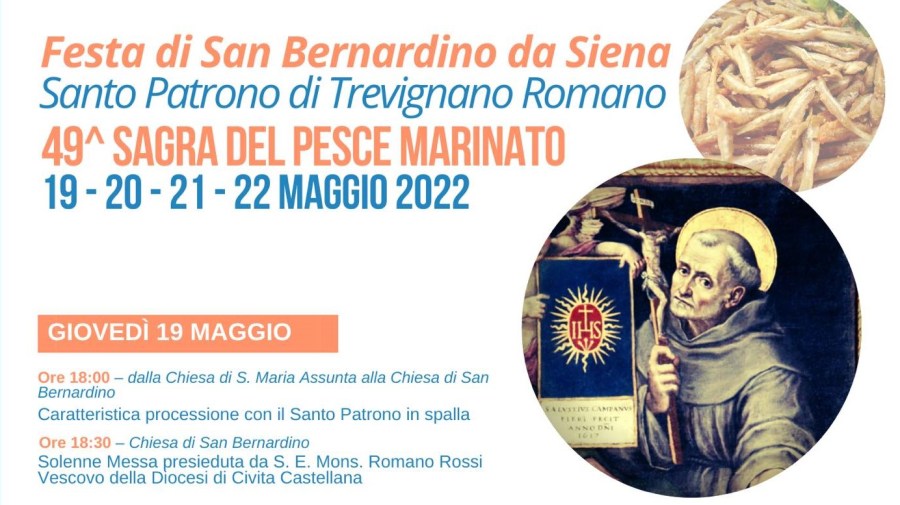
These days Italians remember Bernardino on his feast day for his somewhat cheerier acts. In Trevignano Romano (near Rome), locals have inherited a recipe for preserving fish directly from the saint himself. According to the tale, while assisting the frightened people of Trevignano in the hours before an imminent Saracen invasion, Bernardino told the local fishermen to launch their nets. The expected attack did not occur, and what’s more the fishermen pulled in such an astounding catch it was deemed a miracle, now celebrated annually with the sagra del pesce marinato, or marinated fish festival.

For the festival, fish such as pike, perch, tench, common rudd, and eel are prepared according to the recipe created on that reputedly miraculous occasion. Once cleaned, the fish are cut into pieces, salted, floured, and fried in boiling oil. After resting overnight, the fish is layered into an earthenware container along with small amounts of sage, lemon, and rosemary. Finally, the fish is covered with vinegar and left to marinate for a few days.

pictured: a poster for the 2022 sagra di pesce marinato on occasion of Bernardino’s feast day in Trevignano Romano.

May Day

May Day is an ancient springtime festivity traditionally associated with abundance and rebirth, a moment in the seasonal cycle to celebrate the virtual explosion of life embodied in blooming flowers, lovers, and longer days.

European cultures have been observing May Day for millennia. From the Celtic Beltane and Germanic Walpurgishnacht to Last of April in parts of Scandinavia, the period of April 30-May 1 initiated a crucial phase in the natural cycle of the year and heralded the transition from spring to summer. (For the ancient Romans and others, February 1 was the first day of spring and May 1 the start of summer, which accounts for the term midsummer to describe the summer solstice festivities starting around June 21 and culminating with the Feast of John the Baptist on June 24.)

May Day lives on in various revived folk customs and re-enacted rites of pre-Christian Europe. Song and dance play a major role in these contemporary observances, in a manner reminiscent of other performative calendar customs aligned with the changing of seasons (wassailing, mumming, guising, trick-or-treating, and so on). In Italy, Calendimaggio (from the Latin π‘π‘Žπ‘™π‘’π‘›π‘‘π‘Ž π‘šπ‘Žπ‘–π‘Ž, meaning calends of May), goes by other popular names that reflect this day’s strong association with song: π‘π‘Žπ‘›π‘‘π‘Žπ‘šπ‘Žπ‘”π‘”π‘–π‘œ or π‘π‘Žπ‘›π‘‘π‘Žπ‘Ÿπ‘šπ‘Žπ‘”π‘”π‘–π‘œ, both related to the Italian word cantare, to sing. 

Head out to the Italian countryside today and you might spot troupes of flower-adorned musicians frolicking about, singing their auspicious, entertaining songs in exchange for offerings of eggs, wine, cakes and other sweets. These are the maggerini, or maggiaioli, the May Day singers who delight crowds with lively and symbolic π‘šπ‘Žπ‘”π‘”π‘– π‘™π‘–π‘Ÿπ‘–π‘π‘– (a “maggio” in this context is a type of rhymed couplet), songs proclaiming the joys of the season and young love, always with a good dose of lyrical flair and wit.

As part of the customary farewell to winter darkness and winter habits, Italian women would clean out their larder stores on or around this day, in preparation for the summer bounty to come. Some rather tasty and inventive “pantry soups” derive from this tradition, recipes meant to make use of one’s stored goods. These include garmugia (Lucca), le virtΓΉ (Abruzzo), and the Sicilian specialty macco di fave, typically prepared on or around the feast of Saint Joseph (March 19).

This is day to rejoice in all the precious springtime favorites, like delicate wild asparagus, agretti, May wine infused with sweet woodruff, mint, fresh strawberries, women adorned with pretty flower wreaths and men in verdant leaves and branches. And thoughts of hope, change, and progress as we clear out the cupboards and set a pot on the fire and inhale the intoxicating joy a bouquet of aromatic flowering herbs brings.

image: John Collier’s “Queen Guinevere’s Maying” (1900)

La Festa di San Marco

Mark the Evangelist aka San Marco holds special significance for Venetians, as patron of the city and for whom the principal square and basilica housing his relics are named, alongside countless other centuries-old traditions and honors.

Venetians observe la festa di San Marco with the (almost compulsory) eating a plate of rice and peas, or risi e bisi in Venetian. Tales about this dish are plentiful indeed. In the Republic period, come Saint Mark’s day, risi e bisi was invariably served to the Doge. It’s also said that a true dish of risi e bisi must contain more peas than rice, or at least equal amounts of the two. Anecdotes aside, this famously Venetian dish, often described as half risotto, half soup, is arguably connected more to Mark’s symbolic role in Venetian civic history than to Catholic observance. Its continued popularity reflects both the importance of rice production in the Veneto region and the ready supply of fresh peas in April, the latter thanks to the noted agricultural production of Venice’s smaller islands such as Sant’Erasmo, Vignole, and Torcello, islands that once functioned as fresh produce suppliers to the Venetian populace.

On the other side of the Italian peninsula, in the Nuoro area of Sardinia, the people of the small town Lei honor San Marco with a religious procession to the rural country churches dedicated to him. Among the procession’s participants are local women carrying trays and baskets of small votive breads, pale in color and intricately decorated with flowers, garlands, birds, leaves, and more. These elaborate dainty breads, called cocoietas in the local dialect, are later blessed and dedicated to San Marco, considered protector of the fields.