The Cuckold Tree of Florence

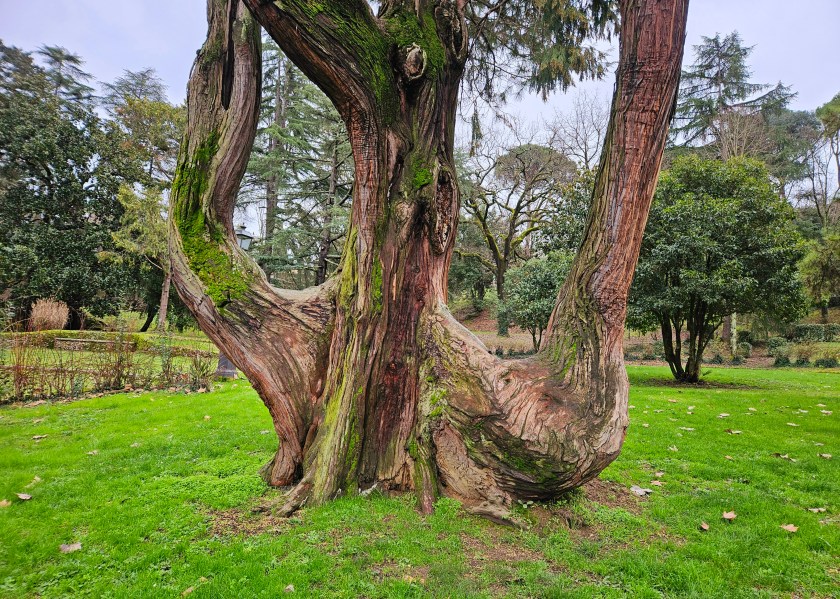
Not far from Piazzale Michelangelo in Florence is a park called Giardino del Bobolino, home to a California incense-cedar tree (Calocedrus decurrens) that in recent decades has become the subject of some quirky local lore.

The Calocedro del Bobolino is approximately 150-200 years old, a relatively young specimen—in their native Pacific Northwest, Calocedrus decurrens can live 500 to 1,000 years—likely planted in the mid-1800s during expansion of this part of Florence. In 1985, violent winds damaged the tree’s trunk, resulting in its current appearance and subsequent nickname: l’albero dei cornuti, or cuckold’s tree. It’s a playful interpretation of the branches’ resemblance to horns and their traditional, if complex and historically murky, associations with infidelity.

Horns have long been considered lucky and protective. In ancient Rome, horn-shaped amulets were worn to protect against an array of perceived malignant forces, including envy (invidia) and the evil eye (il malocchio). Symbolically related is the hand gesture known as the sign of the horns, or gesto delle corna, popular in rock music culture but originally having nothing to do with Satan or devil worship. Rather, the gesture reflects the same protective symbolism and invocation of good luck as horns. Some Italians still make the gesto to counter bad luck, sometimes when receiving a compliment: in popular folk belief, compliments can attract invidia.

In common with horns, phallic symbols also held protective or auspicious significance, as in the case of the fascinus, a Roman amulet worn by men to invoke masculine potency, fertility, and protection, and by women and children for safeguarding against misfortune and a variety of harms. Following the principle of sympathetic magic’s law of similarity (‘like affects like’), the symbolism of phallic charms continued to adapt over the medieval period, retaining a protective association with what we might call ‘phallic matters,’ or men’s sexual vigor in the symbolic sense.

Today, while it’s not exactly common to see people wearing a phallus charm, one does still see Italians wearing a cornicello, the horn-shaped cousin of the phallus traditionally made from red coral. In any case, the association among horns, phallic symbols, and protection, including against social misfortune, persists. For example, to call an Italian man a cornuto—literally horned, figuratively a cuckold—is a strong insult, reflecting a later development of the imagery.

The Bobolino cedar has become a favorite photo-op for newlyweds and honeymooners. Whether for protection, good luck, or merely the beautiful verdant setting, the custom around this botanical curiosity has spurred yet another of its nicknames: l’albero degli sposi, or newlyweds’ tree. To me, this fascinating contemporary ritual seems to acknowledge, regardless of one’s belief system, that all marriages need a little help, a little good luck. 

In 2020, the City of Florence granted the Calocedro del Bobolino special protected status, along with a handful of other trees designated as rare, significantly old, majestic, or unusual.

La Beppa Fioraia: Florence’s Witness to the 19th Century

Giuseppina Caciotti (1809-1891), known to 19th-century Florentines as La Beppa Fioraia, lived most of her life in Porta San Frediano. Her epithet derives from Beppa (for Giuseppina) and her occupation as a flower vendor (fioraio).

She was well-known to Florentines while she lived. And no wonder. Beppa wore a large straw hat and carried a basket brimming with flowers to sell throughout the city: outside the train station, at theater entrances, in front of Florence’s elite coffee houses. She was famous for her informal, even cheeky way with others, often addressing high-society passers-by in an uncommonly familiar manner and giving them curious nicknames of her own imagination.

Beppa has been called Florence’s “witness to the 19th century.” Given her occupation, not much would have escaped Beppa’s sharp eye as she roamed Florentine streets: ceremonies, festivities, accidents, parades, concerts, the comings and goings of notable figures, and politics (Florence was Italy’s capital from 1865 to 1871). According to contemporary accounts, Beppa sold (or gave) flowers to the Grand Duke of Tuscany Ferdinand III, to Belgian King Leopold II and his wife Maria Henriette of Austria, to Florentine aristocrats, and to painters who had studios around Piazza Donatello. By other accounts, she was particularly friendly to soldiers, to whom she would frequently gift one of her flowers. 

Later in the 19th century, an Italian journalist wrote of Beppa: “Of the flower vendors, only Beppa remained, getting up there in years and by then having lost that certain hardiesse joyeuse of hers, still calling everyone zelindino mio*, even King Vittorio Emanuele, who Beppa offered a bouquet every time he arrived or left Florence by train. Other flower vendors played their parts, fleeting or lasting, but none dared challenge Beppa’s territory in front of Caffé Doney.”

In old age Beppa saved up for a house outside Porta Romana. She died on February 6, 1891 at the age of 82.

*Zelindo is a name. Zelindino mio means “my little Zelindo.” But why Beppa called everyone, including the king of Italy, by this nickname remains a mystery.

pictured: two of the only known photographs of Beppa, holding her basket of flowers in both.

Pan di Ramerino: Florentine Rosemary & Raisin Buns for Holy Thursday

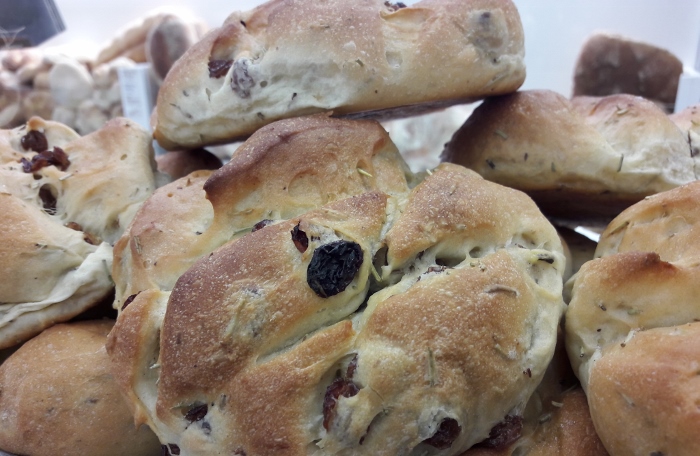
Take an early morning stroll through Florence on Holy Thursday and you’ll likely come across pan di ramerino—soft, round buns made with zibbibo raisins and rosemary—the traditional baked good to enjoy on giovedì santo.

More or less the Italian version of the hot cross bun, pan di ramerino can be found throughout much of the year, yet remains highly associated with Holy Week and Holy Thursday in particular, when area parish priests visit area bakeries to bless the buns.

In addition to the obvious symbolism of the cross, the ramerino (rosemary in Tuscan dialect) used in the preparation of these buns recalls the aromatic oils applied to the body of Jesus Christ on the cross (much like the traditional Roman focaccia made with fennel seeds, also prepared this time of year). Milk and eggs render the buns soft and light, transforming the bread from one that would otherwise have been “lean” to one fitting the close of the Lenten fast and the transition to the celebratory Easter period.

pictured above: pan di ramerino at a Florentine bakery