“They Even Eat Pig’s Blood!” Food, Fear & Friendship in “Welcome to the South”

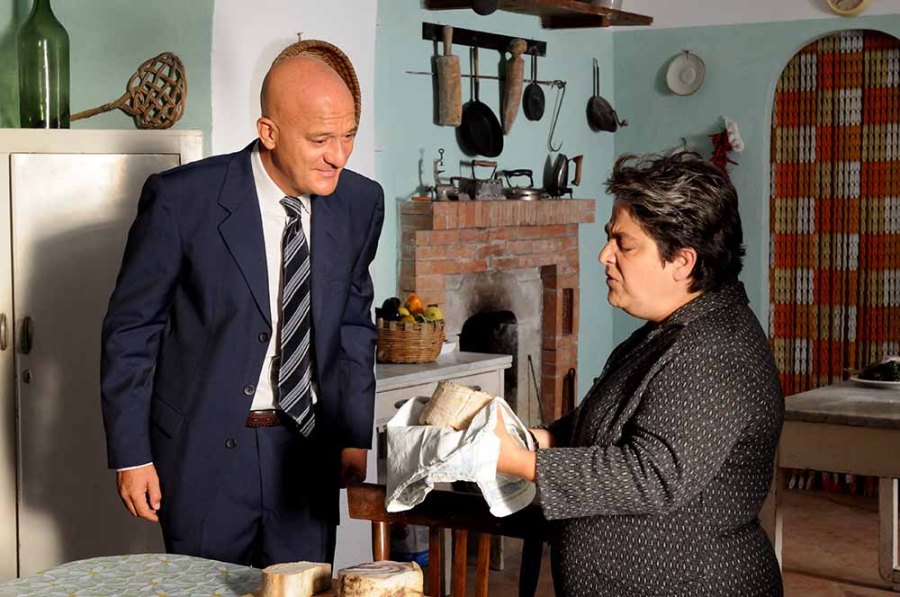
Benvenuti al Sud (2010), an Italian remake of Dany Boon’s Bienvenue chez les Ch’tis, treats the same topic—the social prejudices and stereotypes rooted in a country’s historical north-south divide—with a nearly identical plot and style.

It follows Milanese family man Alberto, a fastidious middle-manager employed by the Italian postal service who, through a series of ridiculous blunders, is sent to work in a small coastal town near Naples. When transplanted to Italy, the socio-geo construct turns on a reversal of that in Boon’s film: whereas Southern France is considered a civilized, even coveted Mediterranean paradise in Bienvenue (Northern France suffering dreary climes and proximity to distasteful, barbaric ways), the reverse is true for Benvenuti.  Here, Milan, Turin, and their respective regions are the seats of civilization, industry, and progress, with Southern Italy the land of rough land laborers, poor manners, and unchecked criminality. 

Benvenuti relies heavily on reciprocal misperceptions, with an emphasis on northern prejudices toward southerners, to deliver the lion’s share of its comedic value. While preparing for his dreaded journey, Alberto decides to leave behind his watch and wedding ring, given the thieves he’s sure to encounter. He packs body armor, which he wears to bed on his first night in a southern home as a guest of his younger colleague and soon-to-be friend, Mattia. Later, in an attempt to assimilate, Alberto dramatically tosses his garbage out the window onto the street below, having heard from a fellow northerner that this is how southerners do things. And so on.

To establish Alberto’s thoroughly Milanese character, before his departure he is seen attending a meeting of the Illustre Accademia del Gorgonzola, a masonic-like brotherhood devoted to the quintessentially Milanese cheese.  (Italy is, in fact, home to many such food societies, complete with rituals shrouded in secrecy and strict hierarchies, modeled on the medieval confraternity.)  During the meeting, a brother warns Alberto about the various dangers in the South, from its shoddily built houses to its ubiquitous truck drivers. Most dangerous of all though is the food, a threat on par with the sickening pollution. The scene introduces a theme that will underpin the rest of the film: the power of food to both divide and unite culturally dissimilar groups. 

The first morning in his new home, Alberto breakfasts with Mattia and Mattia’s mother. Insisting on something light (coffee and dry toast), Alberto is instead offered the sweet egg cream zabaione and a homemade pastry filled with chocolate and pig’s blood. Underlying this humorous (albeit exaggerated) portrayal of contrasting eating styles is a graver topic, however—poverty versus abundance. In the historically poorer Italian South, abundance on the table in the form of richer homemade foods and larger portions is highly significant, while the abstemious, temperate foodways of the “civilized” North reflect a distinct historical privilege. Tellingly, Alberto’s own eating habits evolve alongside his developing friendships as he’s presented with opportunities that dissolve his former taste intolerance.

Charmed by the natural beauty of the area (filming took place in Castellabate, located south of Salerno amid Cilento National Park), friendships, and repeated invitations to dine and socialize with locals, Alberto progresses over the course of his two-year sojourn from a rigid, anxious man hindered more than he realizes by his trace xenophobia to a playful, relaxed man who is clearly happy and confident in his new element. In a scene indicative of his changing nature, he decides to join in the football match in the piazza just outside his post office—something he’d previously shunned as work-shy and inappropriate. Though a bit heavy-handed and predictable, and certainly guilty of perpetuating more than a few hackneyed comedy tropes, Benvenuti al Sud offers many pleasing moments in which our protagonist’s stodgy nature is enlivened, and arguably upgraded, through unlikely friendships. 

Benvenuti also achieves something audiences have come rather increasingly to expect (à la the current genre-blurring era of Netflix original series): a bridging of the gap between comic frivolous and tragic serious, facilitating edification for viewers in the guise of lighter-side entertainment. While Alberto’s errors in judgment evoke conventional comedic twinges of shame, his journey presents him with much loftier moments in which we see him thoughtfully reassessing his own bias. Ostensibly Benvenuti al Sud strives to make us laugh by exposing the folly of these specific Italian v. Italian stereotypes, and indeed it works hard to do this with its comedy. Yet in the dismantling of Alberto’s prejudices—prejudices that in Italian reality are very serious—we witness a character’s hopeful metamorphosis. 

The final scene of Benvenuti is refreshingly poignant, particularly within the otherwise cringey, hyper-cosmetic Italian comedy realm, yet at the same time feels somehow antithetical (ppov) to its own message. As the friends say their farewells, Alberto’s wife Silvia leans towards the visibly pregnant belly of her southern counterpart, Mattia’s now-wife Maria, to welcome il terroncello, or baby southerner, a diminutive derived from the infamous Italian pejorative, terrone. In turn, Maria responds, Ciao, polentona! referencing a common label for northerners, especially Milanese, for whom polenta is a staple. While the latter term draws from the ubiquitous use of food-rooted ethnic slurs to express racist ideology (English speakers will recognize terms like kraut, frog, and beaney, to name a few), it is a far slighter comment than the significant insult terrone, a word loaded with layers of systemic racism and classism, and the complex legacy that comes with that. 

Though delivered affectionately, the exchange continues the film’s relentless reliance on divisive stereotypes for humor, just at the moment we expect something more, something akin to a true rejection of such language, and I admit my dismay here the first time I watched Benvenuti. After subsequent viewings, however, I began to see the scene as a reminder of what has been at stake throughout—changing minds via comedy is a tall order, after all—as well as what has been achieved. Having upended at least a few of the damaging perceptions Benvenuti seeks to address, perhaps it has earned the right to conclude on its own comedic terms.

La Beppa Fioraia: Florence’s Witness to the 19th Century

Giuseppina Caciotti (1809-1891), known to 19th-century Florentines as La Beppa Fioraia, lived most of her life in Porta San Frediano. Her epithet derives from Beppa (for Giuseppina) and her occupation as a flower vendor (fioraio).

She was well-known to Florentines while she lived. And no wonder. Beppa wore a large straw hat and carried a basket brimming with flowers to sell throughout the city: outside the train station, at theater entrances, in front of Florence’s elite coffee houses. She was famous for her informal, even cheeky way with others, often addressing high-society passers-by in an uncommonly familiar manner and giving them curious nicknames of her own imagination.

Beppa has been called Florence’s “witness to the 19th century.” Given her occupation, not much would have escaped Beppa’s sharp eye as she roamed Florentine streets: ceremonies, festivities, accidents, parades, concerts, the comings and goings of notable figures, and politics (Florence was Italy’s capital from 1865 to 1871). According to contemporary accounts, Beppa sold (or gave) flowers to the Grand Duke of Tuscany Ferdinand III, to Belgian King Leopold II and his wife Maria Henriette of Austria, to Florentine aristocrats, and to painters who had studios around Piazza Donatello. By other accounts, she was particularly friendly to soldiers, to whom she would frequently gift one of her flowers. 

Later in the 19th century, an Italian journalist wrote of Beppa: “Of the flower vendors, only Beppa remained, getting up there in years and by then having lost that certain hardiesse joyeuse of hers, still calling everyone zelindino mio*, even King Vittorio Emanuele, who Beppa offered a bouquet every time he arrived or left Florence by train. Other flower vendors played their parts, fleeting or lasting, but none dared challenge Beppa’s territory in front of Caffé Doney.”

In old age Beppa saved up for a house outside Porta Romana. She died on February 6, 1891 at the age of 82.

*Zelindo is a name. Zelindino mio means “my little Zelindo.” But why Beppa called everyone, including the king of Italy, by this nickname remains a mystery.

pictured: two of the only known photographs of Beppa, holding her basket of flowers in both.

Beastmen to Bonfires: Alpine Folk Customs Through the Seasons

The Alps span several geopolitical borders and encompass significant cultural and linguistic diversity, and yet it is a region, when considered as a geographical entity rather than as a serious of nations, united by its folk customs.

Rooted in pre-Christian, nature-worshipping Alpine religions, many local legends, calendar customs, and artisanal crafts in Italy’s Trentino-Alto Adige/South Tyrol continue to reflect the deep connections with the natural landscape that characterize Alpine folklore and folkways. Grounding them all is a ritualistic acknowledgement of the extreme seasonal shifts, isolation, and solitude inherent to mountain life. 

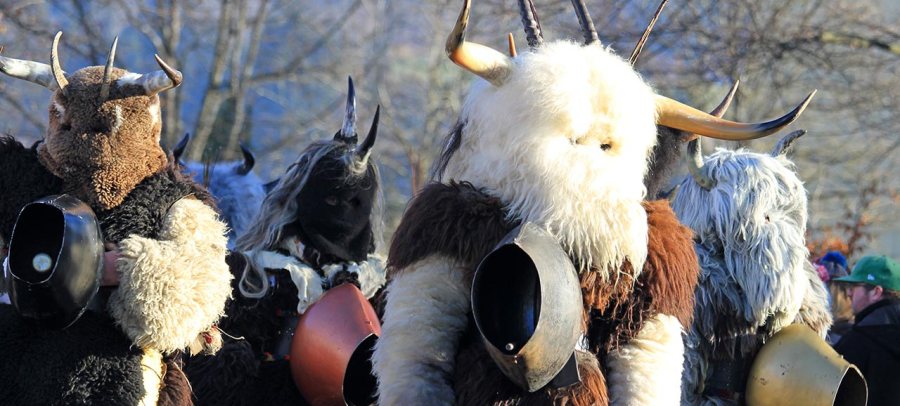
Alpine Beastmen. South Tyrolean festivities that mark significant cyclical transitions—such as the winter and summer solstices, the end of the harvest, or the arrival of spring—feature a host of folkloristic figures who congregate in spectacular public events. These include the Perchtenlauf, followers of the pagan Alpine goddess Perchta who are collectively known as Perchten. The Perchten wear frightful animal costumes and bang on massive drums to drive out winter darkness as they follow their leader, a Hex who symbolically “sweeps up” the previous year’s evil to be tossed into the fire. 

A similar figure is Krampus, another anthropomorphized beastman who inhabits the wintry Alpine and northern European realms. Every year, on the eve of Saint Nicholas Day, Krampuslauf parades take place throughout Trentino-Alto Adige, in towns like Pergine (near Trento) and Dobbiaco (east of Bolzano), with Krampus teasing and terrifying onlookers as part of the larger Saint Nicholas festivities. 

Other customs in this region include the Klöckeln, when costumed figures knock on farmhouse doors in villages like Varna and Scalares in the Val Sarentino on the first three Thursdays of Advent—the Christian liturgical season leading up to the arrival of Christ. Similar to winter mumming, the ritual involves great secrecy among the participants, whose peculiar white masks, long mossy beards, and floppy red noses entirely disguise their identities. According to tradition, sweets and wine must be offered to the Klöckeln, who then conclude the visit by etching a crucifix on or near the threshold, such as on the doorfront or in surrounding snow. 

Wood Carving. South Tyrol’s long tradition of wood carving can be admired in places like Val Gardena in the Dolomites, where local artisans have been carving wooden toys, figurines, and large, elaborate nativity scenes for centuries. Wood carving is also the foundational craft employed to create Krampus’s strikingly grotesque and beastly appearance, typically made from local pine. The masks are then further embellished with ram or goat horns, furs, and faux skins, before being painted to frightening effects. The Maranatha Nativity Museum in Luttago (in the province of Bolzano) houses a collection of these handcrafted masks, with an atelier showcasing their evolution from blocks of wood into depictions of the devilish face we associate with Krampus.

Summer Bonfires. Lighting bonfires—falò in Italian—to mark the summer solstice is an ancient and common practice throughout Europe, derived from pre Christian sun worship rituals that in Italy have merged over centuries with Saint John the Baptist observances in late June. The practice continues today, with the month of June in South Tyrol seeing its mountain slopes and high peaks light up in a dramatic display of flames, creating a wondrous spectacle that spans the dark-of-night landscape for miles. 

In a specific derivation of the midsummer falò tradition, South Tyroleans commemorate the successful Tryolean defeat of Napoleonic forces in June of 1796 with the lighting of Herz-Jesu Feuer, or Sacred Heart of Jesus fires. These fires, which are lit on the third Sunday after Pentecost—coinciding with the summer solstice period—recall the Tyrolean troops’ pledge to the Sacred Heart as they organized their defense against the imminent French invasion. The act of burning immense heart shapes and crosses in June has come to symbolize resistance, Tyrolean unity, and divine protection. 

pictured: Klöckeln in Sarntal Valley; photo @ sudtirol.com 

nb: a version of this piece first appeared in Italy Magazine’s Bellissimo, Winter 2023 Edition, Trentino-Alto Adige. Subscribe here!