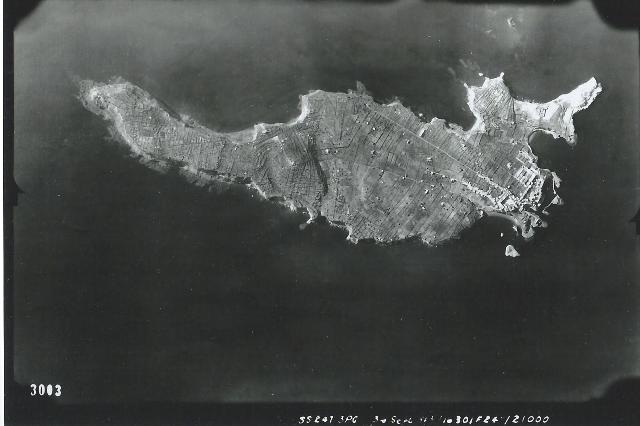
This 1943 military photo of Ventotene is the only known image of its kind. It forms part of the riveting story of the Allied liberation of this tiny Pontine Island off Italy’s Gaeta Coast on the night of September 8, 1943.
Like so many war tales, the liberation of Ventotene contains details both mundane and extraordinary. To give an idea of the island scenario at the time of the Allied arrival, I refer to a paragraph from John Steinbeck’s Once There Was a War, a collection of articles from his time as war correspondent to the New York Herald Tribune in the second half of 1943:
“…there was a radar station on [Ventotene] which searched the whole ocean north and south of Naples. The radar was German, but it was thought that there were very few Germans. There were two or three hundred carabinieri there, however, and it was not known whether they would fight or not. Also, there were a number of political prisoners on the island who were to be released, and the island was to be held by these same paratroopers until a body of troops could be put ashore.”
Strategically speaking, the capture of the island and the German radar was crucial to the Allies, given their operations taking place concurrently in southern Italy—most notably the battles at Salerno from September 9 to 17—and other Italian Campaign operations in that area to come. The mission itself, seemingly simple enough, entailed several potentially critical unknowns. Although there were fewer than 100 Germans on the island (87, to be precise), the Allies had no way of predicting how the larger Italian carabinieri presence referred to by Steinbeck would react, an uncertainty fuelled by the announcement that very day of the Armistice; Italy was no longer at war with the Allies, yet no clear indications had been given to Italian military as to how to proceed, nor how to conduct themselves vis-à-vis their just-yesterday enemies. The infamously confused and chaotic atmosphere created in the wake of the Armistice announcement saw the virtual disintegration of Italy’s armed forces, alongside mass desertions. Yet, at the time these events took place, the carabinieri, Italy’s military police, were considered loyal Fascists (though later, once disbanded, many former carabinieri joined the Italian Resistance).
Ventotene was as well, like the nearby island of Ponza, a penal colony for Mussolini’s political opponents (both islands have been places of exile since the ancient Roman era). In 1943, a number of dissidents and exiles were present on the island. One such exiled elderly gentleman, according to reports, assisted the American troopers of the 509th Parachute Infantry Battalion in carrying out a plan to deceive the occupying Germans into believing the approaching Allied forces were in the hundreds, having been deposited by an attendant fleet. In reality, the mission consisted of 46 troopers and one torpedo boat! The pitch darkness of night made such a deception possible, and a blackout had been in place on Ventotene since the start of the war.
Unbelievable as it seems, the initial “invasion” of Ventotene was conducted by a mere five American troopers. After receiving a signal indicating the stationed Italians’ intention to surrender, they approached the narrow port in a whaleboat, engulfed in a darkness described by Steinbeck as so thick “you could not see the man standing at your shoulder.” One of these soldiers proceeded with the plan, successfully convincing the German lieutenant in charge of Ventotene that he and his forces were far outnumbered. The Germans then surrendered, the carabinieri having already turned in their weapons, and the island was liberated in the middle of the night, without action or injury of any kind—indeed, without a single shot having been fired.
 Writeous Folk