Beastmen to Bonfires: Alpine Folk Customs Through the Seasons

The Alps span several geopolitical borders and encompass significant cultural and linguistic diversity, and yet it is a region, when considered as a geographical entity rather than as a serious of nations, united by its folk customs.

Rooted in pre-Christian, nature-worshipping Alpine religions, many local legends, calendar customs, and artisanal crafts in Italy’s Trentino-Alto Adige/South Tyrol continue to reflect the deep connections with the natural landscape that characterize Alpine folklore and folkways. Grounding them all is a ritualistic acknowledgement of the extreme seasonal shifts, isolation, and solitude inherent to mountain life. 

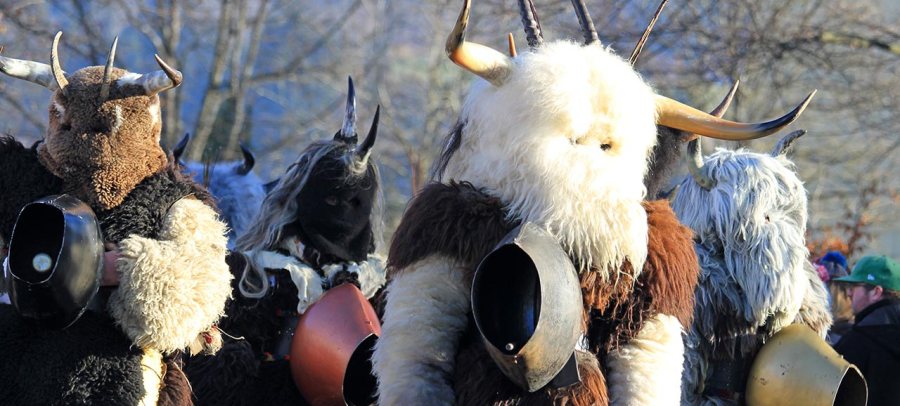
Alpine Beastmen. South Tyrolean festivities that mark significant cyclical transitions—such as the winter and summer solstices, the end of the harvest, or the arrival of spring—feature a host of folkloristic figures who congregate in spectacular public events. These include the Perchtenlauf, followers of the pagan Alpine goddess Perchta who are collectively known as Perchten. The Perchten wear frightful animal costumes and bang on massive drums to drive out winter darkness as they follow their leader, a Hex who symbolically “sweeps up” the previous year’s evil to be tossed into the fire. 

A similar figure is Krampus, another anthropomorphized beastman who inhabits the wintry Alpine and northern European realms. Every year, on the eve of Saint Nicholas Day, Krampuslauf parades take place throughout Trentino-Alto Adige, in towns like Pergine (near Trento) and Dobbiaco (east of Bolzano), with Krampus teasing and terrifying onlookers as part of the larger Saint Nicholas festivities. 

Other customs in this region include the Klöckeln, when costumed figures knock on farmhouse doors in villages like Varna and Scalares in the Val Sarentino on the first three Thursdays of Advent—the Christian liturgical season leading up to the arrival of Christ. Similar to winter mumming, the ritual involves great secrecy among the participants, whose peculiar white masks, long mossy beards, and floppy red noses entirely disguise their identities. According to tradition, sweets and wine must be offered to the Klöckeln, who then conclude the visit by etching a crucifix on or near the threshold, such as on the doorfront or in surrounding snow. 

Wood Carving. South Tyrol’s long tradition of wood carving can be admired in places like Val Gardena in the Dolomites, where local artisans have been carving wooden toys, figurines, and large, elaborate nativity scenes for centuries. Wood carving is also the foundational craft employed to create Krampus’s strikingly grotesque and beastly appearance, typically made from local pine. The masks are then further embellished with ram or goat horns, furs, and faux skins, before being painted to frightening effects. The Maranatha Nativity Museum in Luttago (in the province of Bolzano) houses a collection of these handcrafted masks, with an atelier showcasing their evolution from blocks of wood into depictions of the devilish face we associate with Krampus.

Summer Bonfires. Lighting bonfires—falò in Italian—to mark the summer solstice is an ancient and common practice throughout Europe, derived from pre Christian sun worship rituals that in Italy have merged over centuries with Saint John the Baptist observances in late June. The practice continues today, with the month of June in South Tyrol seeing its mountain slopes and high peaks light up in a dramatic display of flames, creating a wondrous spectacle that spans the dark-of-night landscape for miles. 

In a specific derivation of the midsummer falò tradition, South Tyroleans commemorate the successful Tryolean defeat of Napoleonic forces in June of 1796 with the lighting of Herz-Jesu Feuer, or Sacred Heart of Jesus fires. These fires, which are lit on the third Sunday after Pentecost—coinciding with the summer solstice period—recall the Tyrolean troops’ pledge to the Sacred Heart as they organized their defense against the imminent French invasion. The act of burning immense heart shapes and crosses in June has come to symbolize resistance, Tyrolean unity, and divine protection. 

pictured: Klöckeln in Sarntal Valley; photo @ sudtirol.com 

nb: a version of this piece first appeared in Italy Magazine’s Bellissimo, Winter 2023 Edition, Trentino-Alto Adige. Subscribe here!
Lucia, Bearer of Light

Across the numerous, often ambiguous and always fascinating stories of Lucia, the Sicilian virgin saint who rejected her suitor and gave her dowry to the poor, the one constant is her association with light, clarity, and vision.

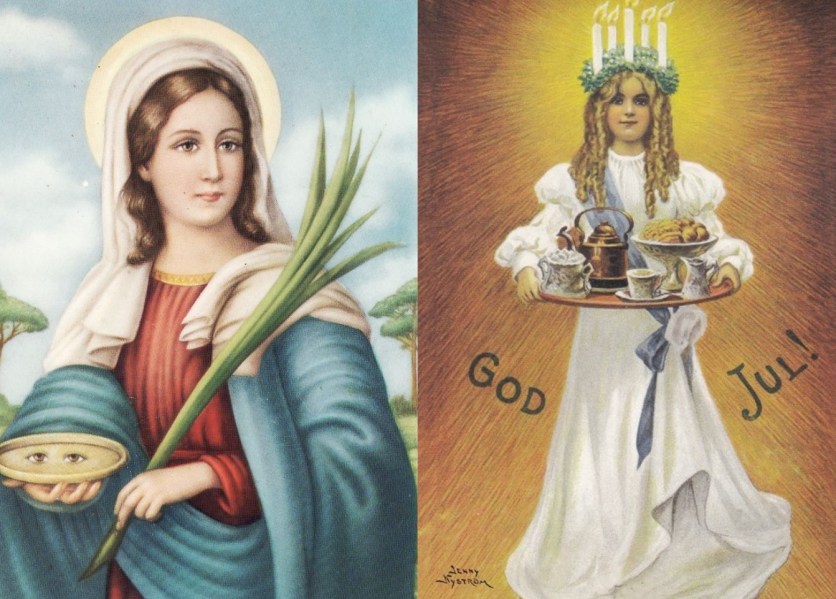
As patron saint of sight—often depicted holding a platter with eyes, her attribute—Lucia protects her Catholic devotees from vision problems/eye diseases. And in Scandinavian countries where Lucia is highly venerated, Sweden especially, her feast day celebrations evoke ancient, heart-of-winter rites meant to illuminate the year’s longest nights. These Lucia festivities, known as Luciafirande, include processions of young women dressed in white who sing Lucia songs and carry candles in her honor.

In folkloristic terms, Lucia figures alongside other Saint Nicholas companions this time of year (indirectly, as she is not part of his processional entourage), characters like Krampus, the red-tongued devilish punisher of bad children, and La Befana, Italy’s frumpy, raggedy Christmas witch who flies around the world on Epiphany eve. Interestingly, Lucia shares qualities with both: depending on the version of the story, Lucia sometimes rides a broom (like La Befana); while in some Swedish traditions, young people dressed as Lucia go about scrounging for schnapps, not unlike their far-creepier counterparts in the Krampus procession.

In Scandinavian tradition, Lucia has a dark sister known as Lussi, a Nordic winter witch said to roam the skies on Lussinatt (“Lucy Night” or winter solstice, traditionally) punishing children and harming livestock. For some, pagan Lussi and Christian Lucia represent dark and light, respectively. Both names actually derive from the Latin word for light, yet for many the name Lussi in particular has become identified with Lucifer (“he who brings light”), leading to popular beliefs connecting her to the underworld and darkness. Lucia, on the other hand, remains consistently associated with whiteness and purity in her various (particularly Catholic) depictions.

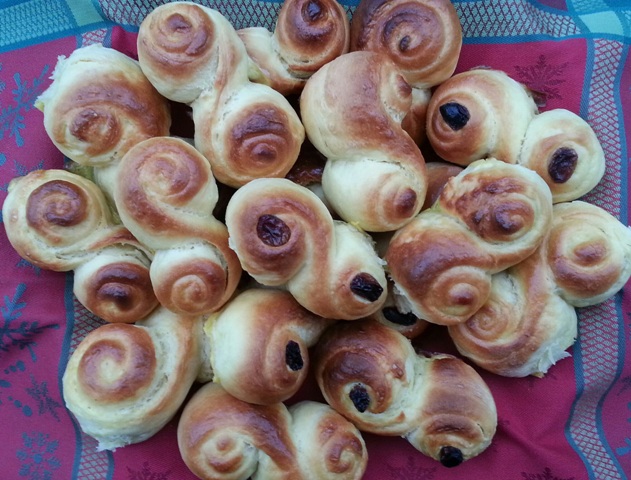
The definitive treat to enjoy during Lucia festivities are Lussekatter, or “Lucy cats”, saffron buns made with raisins meant to recall eyes. 

pictured: my first and only attempt at homemade Lussekatter (2015)

The Dark Winter Companions of Saint Nicholas

Saint Nicholas’s ‘dark’ companions, those whose function is to frighten or punish, often present as beastmen or half-beasts adorned in furs, horns, and claws—costumes in stark contrast to Nicholas’s benignly bearded appearance.

The tradition speaks (in part) to the role these figures play as bridges between deep winter pagan customs involving nature worship and observance of the cycle of light and dark—indeed, the frightful costumes worn are conceived partly as protection against the very real threats posed by winter’s long, dark nights—and later Christianized observances, such as Saint Nicholas processions and Santa Claus’s annual magical delivery of gifts. 

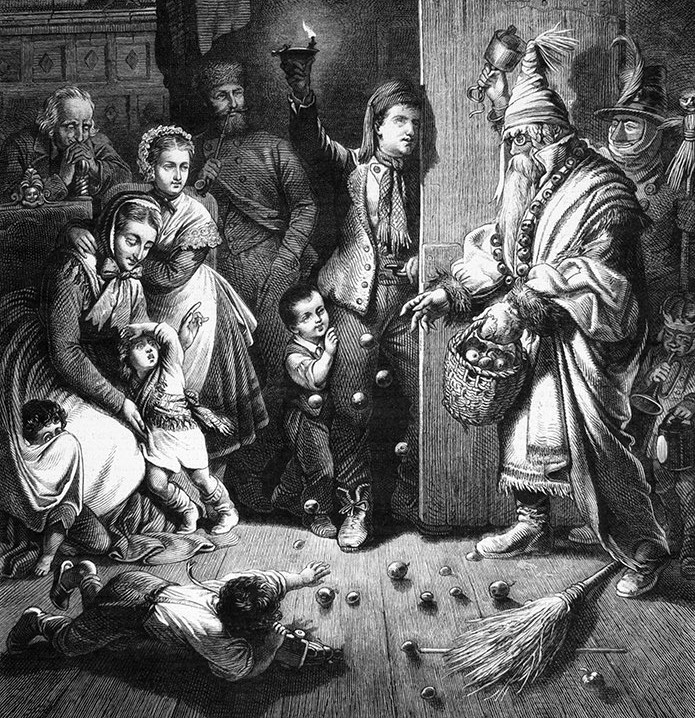
The fascinating figure of Belsnickel, for instance, combines this anthropomorphic beastliness with the ragged look of other Nicholas cohorts (like Italy’s la Befana, a Christmas witch who traditionally appears dressed in tatters). Draped in old furs and looking on the whole rather disheveled, Belsnickel may wear an animal mask of some kind, but he usually shows up to the Saint Nick party looking more man than beast. He’s described as mean and crotchety. He passes out candies and other treats to children, only after having tricked them in some way that involves his ever-present switch / whip. 

With his fellow Christmas cohorts, Belsnickel shares the dual task of delivering presents to good children and punishing bad children. His name derives from the diminutive of Nicholas and a German word that means “to beat severely”, yet an alternative version of his name, Pelznickel, refers to his fur-clad appearance (pelz = pelt). Interestingly, his name might also be related to Krishkinkle, aka Kris Kringle, though it seems the more widely confirmed origin of Kris Kringle is Cristkindle, German for “Christ child.”

Belsnickel is well traveled. He’s known in America, in particular in Pennsylvania, as discussed in this 2018 Pennsylvania Heritage piece that discusses Belsnickel’s evolution and journey from his German and Dutch roots to America with fascinating depth and detail.

pictured: Swiss engraver Karl Janslin’s 1880 portrayal of Belsnickel at the threshold reflects his various functions: though distributing treats to reward the “good” children, he nonetheless has his whip at the ready, while the children hide in fear.